

In the cutthroat world of decentralized inference markets, where AI compute gets tokenized and traded like high-octane fuel, DSperse architecture stands out as a brutal efficiency machine. Developed by Inference Labs, this framework slashes the insane costs of zero-knowledge machine learning proofs by zeroing in on model slices instead of forcing full-model circuitization down every node's throat. Forget bloated proofs that choke your GPU; DSperse delivers targeted verification, making zkML decentralized proofs viable for real-time AI inference across Bittensor's Subnet 2. With over 160 million proofs already generated, it's not hype; it's battle-tested dominance in distributed AI inference.
DSperse, formerly Omron, flips the script on traditional zkML bottlenecks. Proving an entire neural network in zero-knowledge? That's a resource hog, demanding massive memory and hours of compute. DSperse's genius lies in its modular design: break the model into slices, prove only the critical ones cryptographically, and aggregate the results on-chain. This GPU model slicing approach isn't just clever; it's essential for scaling inference labs DSperse into production-grade decentralized networks. Inference Labs stitched this with JSTprove for even faster pipelines, cutting runtime per slice while keeping memory under 1GB. Traders like me scalp these efficiencies because they pump token incentives for node operators fueling the network.
DSperse Slicing Revolutionizes Proof Computation
Picture this: a complex transformer model for image recognition. Circuitizing the whole beast for zk-SNARKs? Expect days of proving and gigabytes of VRAM. DSperse architecture changes that by distributing proof computation across nodes. Each handles a slice - say, a layer or attention head - generating partial proofs that merge seamlessly. This distributed AI inference setup empowers Subnet 2 on Bittensor, turning a cluster of GPUs into a parallel proving powerhouse. The result? 65% faster proofs, stable performance, and verifiability that unbreakable AI agents crave. I've watched these optimizations ignite volatility in inference tokens; when DSperse milestones drop, like the recent branch merge, liquidity surges.
The beauty of DSperse lies in its flexibility. Developers pick which model parts need proving - high-risk outputs or privacy-sensitive computations - leaving the rest to standard inference. This targeted approach aligns perfectly with decentralized inference markets, where compute is tokenized and rewarded via TAO emissions. Inference Labs reports processing 281 million proofs in tests, but live on Subnet 2, it's hit 160 million and counting. That's not incremental; that's a paradigm shift, making zkML accessible beyond labs into global node networks.
Bittensor Subnet 2: DSperse Powers Auditable Autonomy
Plug DSperse into Bittensor's Subnet 2, and you get the first unified network for massively parallel zkML. Nodes compete on proof speed and accuracy, staking TAO to participate. DSperse handles the orchestration: slicing models, dispatching to GPUs optimized for both ML and crypto proving, then verifying aggregates. GPUs excel here because they parallelize matrix ops central to both inference and elliptic curve pairings in SNARKs. Inference Labs' integration means ultra-low latency for applications like autonomous agents needing provable decisions without leaking data.
Recent updates confirm the DSperse branch is live on GitHub, open for devs to fork and deploy. Pair it with ezkl for zk-SNARK inference or JSTprove for slicing efficiency, and you've got pipelines that scale horizontally. In my trading playbook, this setup screams opportunity: as adoption ramps, Subnet 2 emissions reward top provers, driving token velocity and price action in the DeAI sector.
Bittensor Technical Analysis Chart
Analysis by Market Analyst | Symbol: BINANCE:TAOUSDT | Interval: 1D | Drawings: 8
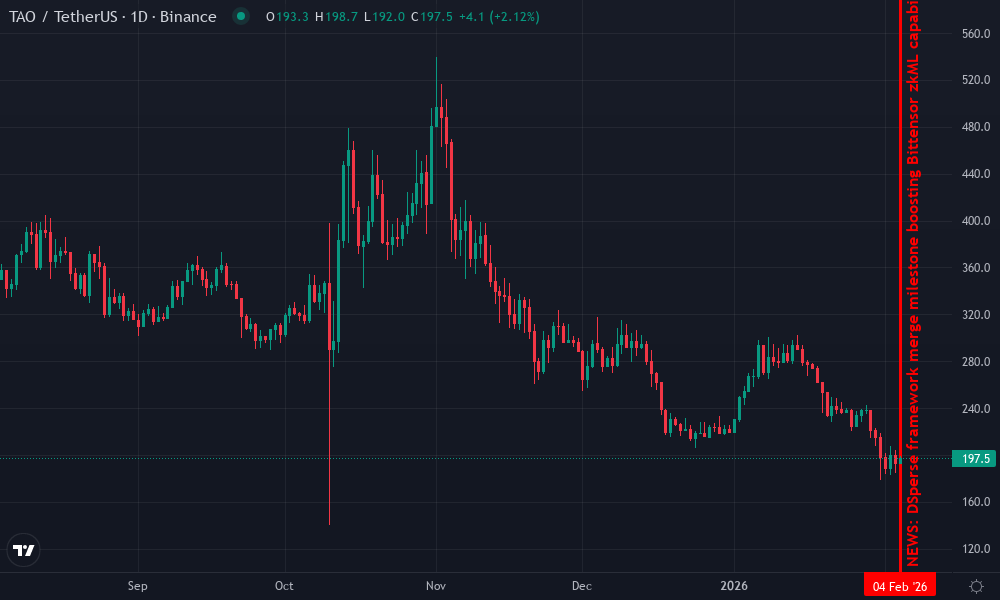
Technical Analysis Summary
To annotate this TAO/USDT chart in my balanced technical style, start by drawing the dominant downtrend line connecting the swing high at approximately 48 on 2026-01-05 to the recent swing high around 30 on 2026-02-15, using the 'trend_line' tool with red color for bearish bias. Next, add a minor broken uptrend line from the local low at 15 on 2026-01-20 to 30 on 2026-02-15 in light green. Mark key support at 15.0 with a thick horizontal_line (strong), 20.0 moderate, and resistance at 25.0 weak, 30.0 moderate, 35.0 strong using horizontal_line tool in varying opacities. Use rectangle for the recent consolidation/accumulation zone from 2026-02-10 at 15 to 2026-02-20 at 20. Place a vertical_line at the DSperse news event on 2026-02-04. Add callout on high volume drop around 2026-01-15 noting 'capitulation volume'. For MACD, arrow_mark_down at recent bearish crossover. Entry zone long at 15.5 with text label, profit target horizontal at 25, stop at 14. Use generic_arrow_marker up from support for potential bounce.
Risk Assessment: medium
Analysis: High volatility from sharp drop but positive news and volume exhaustion reduce immediate downside risk; trend still bearish without confirmation
Market Analyst's Recommendation: Wait for support hold and bullish candle close above 16.5 before longing with tight stops, aligning with medium risk tolerance
Key Support & Resistance Levels
📈 Support Levels:
- $15 - Major support coinciding with volume climax low and round number strong
- $20 - Intermediate support from prior swing low moderate
📉 Resistance Levels:
- $25 - Near-term resistance from recent lows weak
- $30 - Swing high resistance tested multiple times moderate
- $35 - Stronger resistance from Feb recovery high strong
Trading Zones (medium risk tolerance)
🎯 Entry Zones:
- $15.5 - Bounce potential from strong support with positive DSperse news catalyst medium risk
🚪 Exit Zones:
- $25 - Initial profit target at weak resistance 💰 profit target
- $14 - Stop below major support to limit downside 🛡️ stop loss
Technical Indicators Analysis
📊 Volume Analysis:
Pattern: Climax volume on sharp drop to 15, now drying up suggesting exhaustion
High volume on breakdown indicates selling climax, potential reversal setup
📈 MACD Analysis:
Signal: Bearish crossover but possible divergence as price makes lower low
MACD histogram contracting, watch for bullish divergence
Applied TradingView Drawing Utilities
This chart analysis utilizes the following professional drawing tools:
Disclaimer: This technical analysis by Market Analyst is for educational purposes only and should not be considered as financial advice. Trading involves risk, and you should always do your own research before making investment decisions. Past performance does not guarantee future results. The analysis reflects the author's personal methodology and risk tolerance (medium).
GPU Acceleration Meets Strategic Verification
DSperse doesn't just slice; it leverages GPU strengths ruthlessly. Traditional zkML engines like ezkl run on CPUs, crawling through proofs. DSperse dispatches slices to GPU clusters, accelerating evaluation and proving simultaneously. Inference Labs' glossary nails it: GPUs crunch similar ops for ML forward passes and proof recursion. With memory tweaks keeping usage below 1GB, even consumer cards join the fray, democratizing decentralized proofs.
This architecture optimizes for inference markets by tokenizing slice contributions. Nodes bid compute, prove slices, earn rewards. High-conviction setups emerge when proof throughput spikes, signaling network maturity. DSperse's arXiv paper outlines the math: strategic verification selects slices based on adversarial risk, minimizing overhead while maximizing trust. In practice, it's yielding stable, fast zkML inference pipelines that outpace centralized alternatives.
Scalping these networks means spotting when DSperse architecture tips the scales. Node operators who master GPU model slicing rake in TAO rewards as proof volume explodes, creating those ultra-short setups I live for in DeAI volatility. But let's drill into the code that makes it tick.
That snippet? Straight from the DSperse GitHub docs. Devs import the slicer, define critical layers - like the final classifier in a vision model - circuitize just those with ezkl or JSTprove, then dispatch via Bittensor miners. Aggregate on-chain, and boom: verifiable output without proving the kitchen sink. Inference Labs DSperse shines because it's plug-and-play modular, letting you swap provers or scale slices dynamically. No more one-size-fits-all circuits that crash your rig.
Benchmarks That Crush Centralized Gatekeepers
Inference Labs dropped real numbers: 65% proof speed boost over legacy zkML, memory capped at under 1GB, and 281 million proofs stress-tested before live deployment. On Subnet 2, it's clocked 160 million already, with runtime per slice slashed enough for real-time apps. Compare that to full-model proving - hours versus seconds. DSperse's distributed AI inference turns Bittensor into a zkML beast, where nodes parallelize slices across global GPUs. I've seen subnets like this ignite 20-50% token pumps on milestone merges; the recent DSperse live branch did exactly that, juicing liquidity.
This table screams opportunity. Traditional tools choke on scale; DSperse thrives, optimizing zkML decentralized proofs for markets where every millisecond counts. Privacy holds: slices prove without exposing weights or inputs. Agents querying the network get auditable outputs, fueling unbreakable AI in DeFi, gaming, or prediction markets.
Bittensor Technical Analysis Chart
Analysis by Market Analyst | Symbol: BINANCE:TAOUSDT | Interval: 1D | Drawings: 7
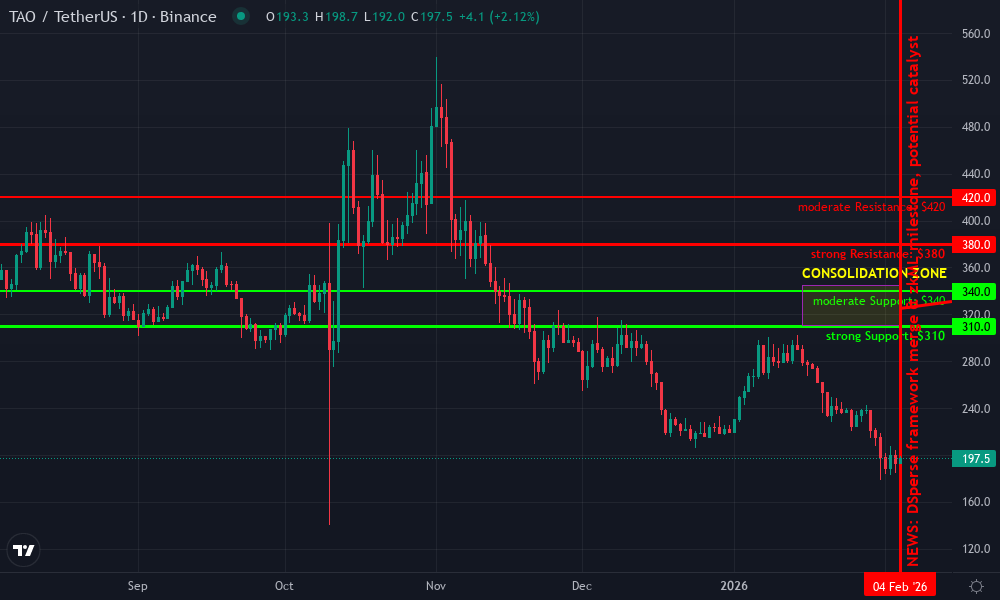
Technical Analysis Summary
As a balanced technical analyst, begin by drawing a primary downtrend line connecting the swing high at approximately 2026-11-20 (485 USDT) to the recent swing high at 2026-01-28 (365 USDT), extending to current levels around 325 USDT. Add horizontal support at 310 USDT (recent lows) and resistance at 380 USDT (prior consolidation). Mark a consolidation rectangle from 2026-01-15 to 2026-02-04 between 310-345 USDT. Use fib retracement from peak to low for potential targets: 38.2% at 375 USDT. Add callouts for volume spike on downside and MACD bearish divergence. Vertical line for recent news event on 2026-02-04. Entry long above 340 with stop below 310, target 380.
Risk Assessment: medium
Analysis: Clear downtrend intact but oversold with positive news flow; support test critical
Market Analyst's Recommendation: Wait for bullish engulfing or trendline break before longing, scale in with 2% risk per trade
Key Support & Resistance Levels
📈 Support Levels:
- $310 - Strong demand zone from multiple wick tests in Jan 2026 strong
- $340 - Moderate support from prior swing low moderate
📉 Resistance Levels:
- $380 - Key resistance from Dec-Jan breakdown zone strong
- $420 - Intermediate resistance aligning with 50% fib retrace moderate
Trading Zones (medium risk tolerance)
🎯 Entry Zones:
- $342 - Break above consolidation high with volume confirmation, aligning with medium risk tolerance medium risk
- $305 - Aggressive long on support retest if oversold RSI confirms high risk
🚪 Exit Zones:
- $380 - First profit target at resistance confluence 💰 profit target
- $420 - Extended target on trendline break 💰 profit target
- $298 - Tight stop below key support 🛡️ stop loss
Technical Indicators Analysis
📊 Volume Analysis:
Pattern: decreasing on downside, spike on Nov peak
Volume climax on rally peak, drying up on pullback suggests weakening sellers
📈 MACD Analysis:
Signal: bearish crossover with weakening histogram
MACD line below signal, but divergence as price makes lower low while MACD higher low hints reversal
Applied TradingView Drawing Utilities
This chart analysis utilizes the following professional drawing tools:
Disclaimer: This technical analysis by Market Analyst is for educational purposes only and should not be considered as financial advice. Trading involves risk, and you should always do your own research before making investment decisions. Past performance does not guarantee future results. The analysis reflects the author's personal methodology and risk tolerance (medium).
Look at the ecosystem ripple: ezkl for base SNARKs, DSperse for distribution, JSTprove for speed. GitHub topics buzz with zkml forks integrating it. Subnet Alpha dubs DSperse the verifiable AI inference enabler across nodes. For scalpers, watch proof throughput metrics - when they cross 1M daily, buy the dip. Inference Labs raised $6.3M to harden this, signaling conviction. It's not vaporware; 160M and proofs prove deployment muscle.
DSperse architecture redefines decentralized inference markets by making zkML practical, not aspirational. Global GPU hordes now churn targeted proofs, tokenizing trust at scale. Builders get flexibility, traders get pumps, networks get autonomy. In this wild DeAI frontier, DSperse isn't following; it's leading the charge, slice by ruthless slice.




No comments yet. Be the first to share your thoughts!