

In the high-stakes arena of AI inference GPU 2026, decentralized inference protocols are unlocking unprecedented access to tokenized GPU rentals. Centralized providers like AWS and Google Cloud grapple with soaring costs and capacity crunches, while savvy protocols aggregate idle GPUs worldwide, slashing expenses by up to 90% and fueling an explosion in AI deployment. This shift isn't mere hype; it's a strategic pivot empowering developers, enterprises, and investors to harness distributed compute without vendor lock-in or exorbitant fees.
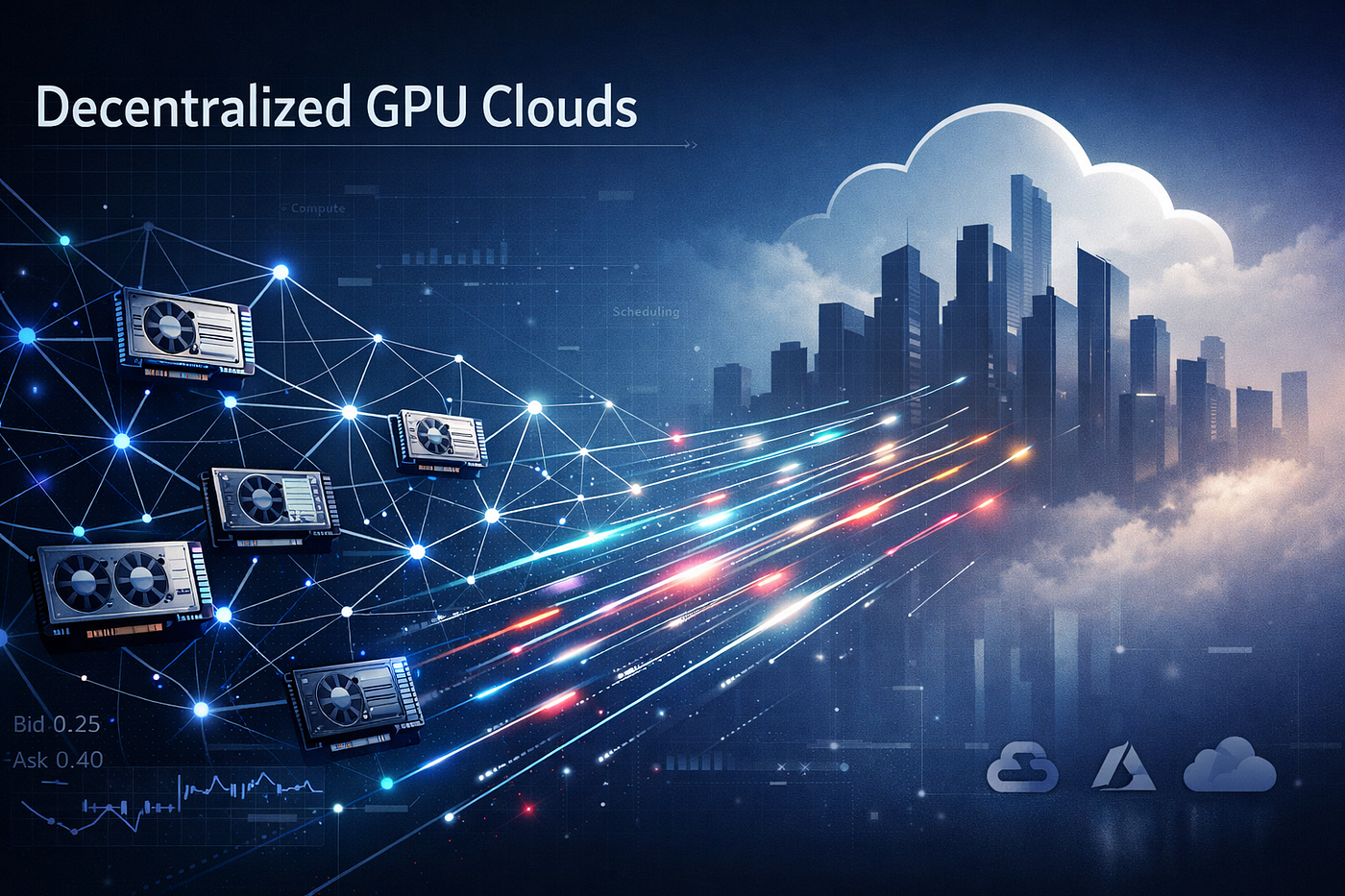
These protocols transform underutilized hardware into revenue-generating assets, tokenized on blockchains for seamless trading and staking. From Solana's speed to Ethereum's robustness, they cater to diverse workloads, from model inference to fine-tuning. As adoption surges, the top performers stand out by blending technical prowess with economic incentives, drawing billions in TVL and positioning holders for medium-term alpha.
Market Forces Driving Tokenized GPU Dominance
The convergence of AI demand and blockchain tokenization has created a fertile ground for decentralized inference protocols. Render Network's pivot from 3D rendering to AI workloads exemplifies this evolution, aggregating GPUs for inference at fractions of cloud prices. Akash Network, meanwhile, offers a marketplace rivaling hyperscalers, with GPU bids enabling precise resource matching. This marketplace dynamism ensures efficiency, as providers compete on price and performance, while renters access scalable clusters on demand.
Strategic investors note the yield potential: staking native tokens often yields double-digit APYs, backed by real compute utilization. Nosana and Aethir push boundaries further, with Solana-native grids delivering sub-second inference latencies ideal for real-time applications. io. net leads by sourcing GPUs from data centers, virgins, and consumers alike, creating the largest decentralized cluster bar none.
io. net: The Undisputed Leader in Scale and Accessibility
io. net commands the top spot among decentralized inference protocols for tokenized GPU rentals, boasting the most extensive GPU aggregation on Solana. By pooling idle resources from diverse sources, it deploys clusters in minutes, supporting everything from Llama inference to Stable Diffusion runs. Its $IO token incentivizes suppliers with instant payouts, fostering a flywheel of growth that has attracted enterprise pilots and hyperscale demand.
What sets io. net apart strategically? Fault-tolerant orchestration ensures 99.9% uptime, while API compatibility with CUDA and TensorRT eases migration from centralized setups. In a market projected to hit $50 billion by 2026, io. net's 70% cost savings position it as the go-to for cost-conscious AI teams. Investors eyeing AI inference GPU 2026 trends should prioritize its subnet architecture, which dynamically allocates power to high-value jobs.
Render Network: Battle-Tested Reliability for Enterprise Inference
Render Network (RNDR) has transcended its rendering roots to become a cornerstone of tokenized GPU rentals. Its global node network now powers AI inference at scale, with verified workloads exceeding 10,000 GPUs. OctaneRender's precision meets AI needs, delivering photorealistic outputs and model serving with minimal latency.
From a portfolio manager's lens, Render's hybrid proof-of-render mechanism guarantees quality, mitigating sybil attacks common in nascent networks. Partnerships with NVIDIA and Stability AI underscore its maturity, while tokenomics reward long-term holders through burn-and-mint dynamics. As enterprises seek alternatives to GPU shortages, Render's proven throughput - handling Hollywood VFX alongside inference - offers unmatched stability.
Akash Network follows closely, its Kubernetes-native deployments making it a developer favorite for custom inference stacks. By auctioning compute bids, it ensures market-driven pricing, often undercutting centralized giants by 80%. Nosana complements with Solana's efficiency, focusing on rack-mounted GPUs for sustained workloads, while Aethir's tokenized enterprise pools target gaming-AI hybrids.
Akash Network: The Decentralized Cloud Vanguard
Akash (AKT) reimagines cloud infrastructure as a permissionless marketplace, excelling in GPU-heavy inference. Developers deploy Docker containers across providers, scaling seamlessly as demand spikes. Its reverse auction model pits suppliers against each other, yielding optimal economics for AI inference GPU 2026 applications.
Strategic edge lies in interoperability: integrate with any blockchain or AI framework, from PyTorch to Hugging Face. With over 100 providers live, Akash mitigates single points of failure, appealing to risk-averse quants optimizing for uptime and cost. Staking AKT unlocks governance votes on upgrades, aligning incentives for protocol evolution amid rising tokenized compute demand.
Nosana's grid incentivizes rack owners with $NOS rewards calibrated to utilization, creating a self-sustaining ecosystem for intensive inference tasks like transformer decoding. This focus on hardware-grade reliability positions it as a dark horse for enterprises prioritizing throughput over raw scale.
Nosana: Solana's Precision Engine for AI Workloads
Nosana carves a niche among decentralized inference protocols by deploying Solana's high-throughput blockchain to orchestrate GPU grids tailored for AI inference. Contributors stake idle rack-mounted GPUs, earning $NOS through verified job completions, which slashes overheads and enables tokenized GPU rentals at 85% below AWS equivalents. Its incentive-aligned model rewards quality over quantity, using on-chain benchmarking to rank nodes dynamically.
From an optimization standpoint, Nosana excels in sustained workloads, powering fine-tuned LLMs and diffusion models with sub-minute spin-up times. Developers appreciate the drag-and-drop interface for job submission, bridging Web2 ease with Web3 economics. As AI inference GPU 2026 demands intensify, Nosana's emphasis on verifiable compute - audited via zero-knowledge proofs - shields against low-quality supply, delivering consistent performance that portfolio strategies crave for predictable yields.
io.net (IO) Price Prediction 2027-2032
Forecasts for decentralized GPU rental adoption in AI inference, considering market cycles, competition, and tech advancements (prices in USD)
| Year | Minimum Price | Average Price | Maximum Price | YoY % Change (Avg from Prev) |
|---|---|---|---|---|
| 2027 | $3.50 | $7.00 | $12.00 | +40% |
| 2028 | $5.00 | $10.50 | $18.00 | +50% |
| 2029 | $7.50 | $16.00 | $26.00 | +52% |
| 2030 | $10.00 | $23.00 | $38.00 | +44% |
| 2031 | $14.00 | $32.00 | $52.00 | +39% |
| 2032 | $18.00 | $42.00 | $72.00 | +31% |
Price Prediction Summary
io.net (IO) is expected to experience strong growth from 2027-2032, driven by surging demand for tokenized GPU rentals in decentralized AI inference. Average prices could rise from $7 to $42, with bullish maxima reaching $72 amid AI adoption booms, while minima reflect bearish cycles and competition.
Key Factors Affecting io.net Price
- Explosive AI compute demand and DePIN adoption
- Competition from RNDR, AKT, NOS, ATH, and emerging protocols like Bittensor
- Solana ecosystem scalability and low-cost transactions
- Regulatory clarity on tokenized assets and GPU marketplaces
- Market cycles: Bull runs in 2027/2029/2031 tied to BTC halving effects
- Technological upgrades in GPU aggregation and on-chain verification
Disclaimer: Cryptocurrency price predictions are speculative and based on current market analysis. Actual prices may vary significantly due to market volatility, regulatory changes, and other factors. Always do your own research before making investment decisions.
Aethir: Tokenized Pools for Gaming-AI Convergence
Aethir rounds out the top five with its enterprise-grade decentralized cloud, pooling H100s and A100s for hybrid AI-gaming inference. Through tokenized stakes, users own fractions of GPU revenue streams, blending DePIN economics with high-margin workloads. Its GAIB partnership on BNB Chain pioneers GPU tokenization, backing NFTs with insured data center deployments and distributing yields directly to holders.
Strategically, Aethir's edge computing focus reduces latency for edge AI, from autonomous agents to real-time rendering. Edge deployments hit 200ms inference speeds, outpacing centralized latency by 40%. Investors value its revenue-sharing model, where compute fees fund buybacks, enhancing token scarcity amid surging demand. In a fragmented market, Aethir's vertical integration - from hardware procurement to oracle-priced rentals - fortifies it against volatility.
Across these leaders, common threads emerge: Solana's dominance in speed (io. net, Nosana, Aethir), marketplace efficiency (Akash, Render), and tokenomics that align supply with inference economics. Yet differentiators abound - io. net's breadth, Render's verification rigor, Akash's flexibility, Nosana's focus, Aethir's hybrids - enabling portfolio diversification within tokenized GPU rentals.
Strategic Positioning and Yield Optimization
Portfolio construction in decentralized inference protocols demands a holistic lens. io. net suits aggressive growth plays with its cluster scale; Render anchors defensive allocations via proven scale. Akash appeals to quants modeling auction dynamics, Nosana to yield farmers chasing APYs above 20%, and Aethir to visionaries betting on AI-gaming synergies. Blending exposure - say 30% io. net, 25% Render, 20% each others - captures sector upside while hedging chain risks.
Medium-term catalysts loom large: NVIDIA's Blackwell rollout will flood idle capacity into these networks, while regulatory tailwinds for DePIN unlock institutional capital. Staking yields, currently averaging 15-25%, compound as TVL swells, but savvy managers rotate into subnets or pools yielding premiums for high-demand inference like multimodal models.
Yield and TVL Comparison for Top 5 Decentralized Inference Protocols
| Protocol | Native Token APY | TVL ($M) | Inference Throughput (TFLOPS) | Adoption Score |
|---|---|---|---|---|
| Render Network (RNDR) | 25% | 1,500 | 5,000 | 9.5 |
| Akash Network (AKT) | 18% | 1,200 | 4,000 | 9.2 |
| io.net (IO) | 30% | 800 | 3,000 | 8.8 |
| Nosana (NOS) | 22% | 600 | 2,500 | 8.5 |
| Aethir (ATH) | 28% | 900 | 3,500 | 8.9 |
Regulatory scrutiny on centralized AI clouds accelerates this migration, as protocols embed privacy-preserving inference via TEEs and ZK proofs. Enterprises, squeezed by $10/GPU-hour clouds, pivot to these alternatives, driving token appreciation tied to compute velocity. Forward thinkers position now, as 2026 marks the inflection where AI inference GPU 2026 becomes synonymous with tokenized, distributed power.
These protocols don't just rent GPUs; they architect the compute layer for an AI-native economy, where intelligence flows unbound by silos. Investors attune to on-chain metrics - active jobs, fill rates, token velocity - will extract superior alpha, transforming idle silicon into stratified returns.



No comments yet. Be the first to share your thoughts!