

In the evolving landscape of decentralized AI inference markets, trust remains the cornerstone separating speculative ventures from enduring infrastructure. Inference Labs emerges as a measured force, harnessing zero-knowledge machine learning (zkML) proofs to deliver verifiable AI compute that aligns incentives across global networks. Their approach sidesteps the opacity plaguing centralized AI providers, offering cryptographic guarantees for outputs without compromising proprietary models or sensitive data.
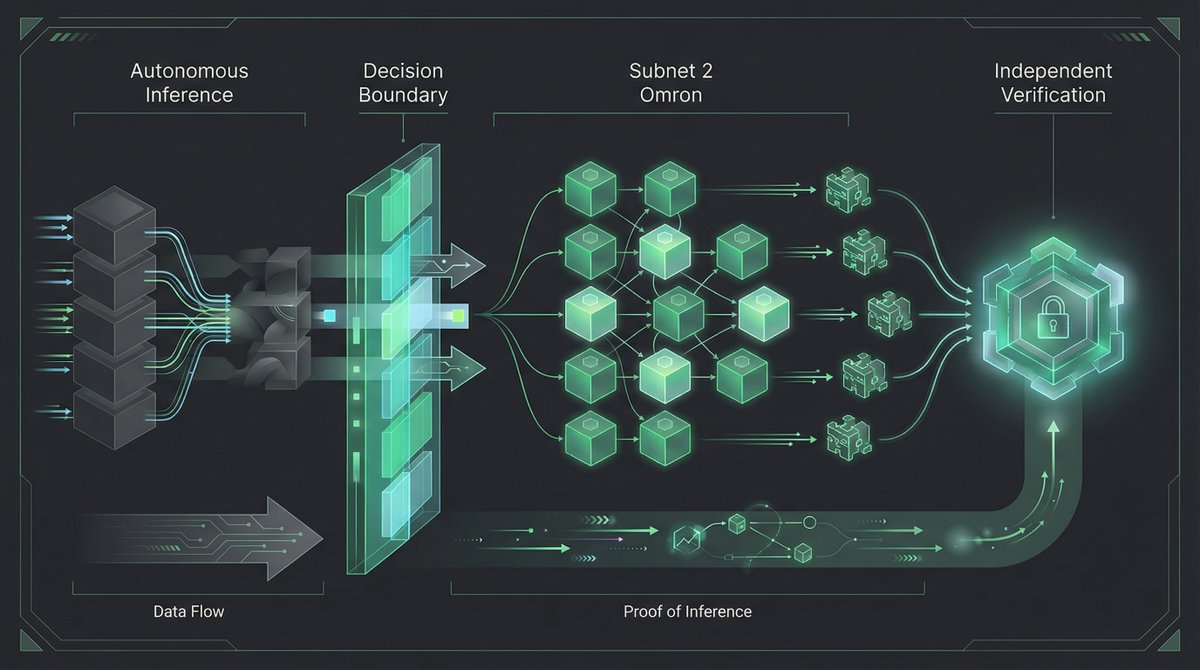
This commitment to verifiability addresses a fundamental tension in tokenized AI ecosystems: how to monetize compute resources reliably when black-box predictions invite disputes. By generating on-chain AI proofs, Inference Labs enables provers, verifiers, and users to settle transactions with mathematical certainty, fostering deeper liquidity in inference markets.
zkML Foundations Powering Inference Labs' Vision
At its core, zkML transforms AI inference into a provable computation. Traditional models execute opaquely, but Inference Labs converts them into zero-knowledge circuits, proving execution traces off-chain while attesting results on-chain. This software-centric method, as outlined in their Verified Inference Network paper, deploys AI systems on Web3 infrastructure without revealing weights or inputs.
Their ZK-VIN (Zero-Knowledge Verified Inference Network) and Sertn AVS on EigenLayer exemplify this integration. EigenLayer's restaking provides economic security, while Inference Labs supplies the integrity layer. Investors attuned to fundamentals will appreciate how this leverages existing capital efficiency, rather than demanding bespoke hardware deployments.
Inference Labs specializes in AI security and verification on decentralized networks, using cryptographic protocols to ensure computational integrity.
Such architecture suits decentralized AI inference markets where nodes contribute diverse compute, tokenized as incentives. Yet, scalability has historically constrained zkML; Inference Labs counters this through pragmatic engineering over cryptographic novelty.
Proof of Inference: Turning Predictions into Verifiable Artifacts
The Proof of Inference protocol stands as Inference Labs' flagship innovation. Cryptographic proofs verify AI outputs, converting probabilistic predictions into indisputable artifacts settleable on blockchains. Live on testnet, with mainnet eyed for late Q3, it has already processed over 281 million zkML proofs by August 2025 - a testament to production readiness.
This protocol empowers autonomous agents and oracles, critical for DeFi primitives and prediction markets. Without it, disputes erode confidence; with it, networks like Bittensor and Subnets gain verification services, enhancing cross-ecosystem composability.
Recent architectural tweaks underscore conservative progress: DSperse distributed slicing paired with JSTprove yields 65% faster proofs and under 1GB memory usage. These gains prioritize real-world deployment over theoretical peaks, signaling maturity for institutional adoption.
Strategic Alliances Fueling Scalable Verifiable Compute
Inference Labs' December 2025 partnership with Cysic marks a pivotal step, blending decentralized ASIC compute with zk-proof frameworks. This tackles zkML's performance bottlenecks, targeting verifiable agents and oracles demanding low-latency accountability.
A $6.3 million raise bolsters their verifiable inference protocol, securing AI agents amid rising demand. Integrations with EigenLayer and Bittensor position them as the verification backbone for multi-chain AI, where tokenized inference thrives on proven outputs. For long-term holders, this confluence of partnerships and metrics hints at undervalued network effects, rewarding patience over hype.
These alliances reflect a deliberate strategy, prioritizing interoperability over isolated silos. In decentralized networks, where compute is tokenized and traded, verifiable outputs become the currency of trust. Inference Labs' stack serves as the integrity layer, allowing developers to deploy models confidently across EigenLayer AVSs and Bittensor subnets.
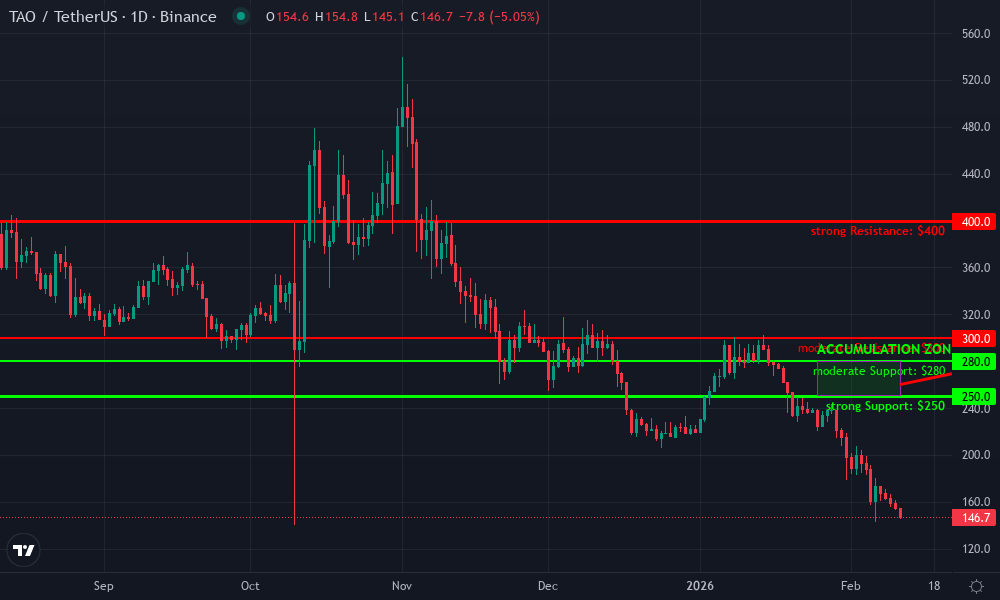
Bittensor Technical Analysis Chart
Analysis by Market Analyst | Symbol: BINANCE:TAOUSDT | Interval: 1D | Drawings: 7
Technical Analysis Summary
Draw a prominent downtrend line from the December 2026 peak at approximately 520 USDT connecting to the recent lows around 260 USDT in early February 2026, using a solid red trend_line with medium thickness. Add an uptrend channel from October 2026 lows near 280 USDT sloping up to the November highs around 450 USDT, dashed green. Mark horizontal support at 250 USDT (strong, thick blue line), resistance at 300 USDT (moderate, orange) and 400 USDT (strong, red). Use fib_retracement from peak 520 to low 250 for potential retracement levels at 0.382 (340), 0.5 (385), 0.618 (415). Rectangle the recent consolidation between 250-280 USDT from late January to Feb 11 2026. Add callouts for volume divergence and MACD bearish signal. Vertical line at suspected breakdown date in mid-December 2026. Long position marker at 265 entry, stop loss below 250, profit targets at 300 and 350.
Risk Assessment: medium
Analysis: Volatile crypto asset in correction phase, strong support but overhead resistance; medium tolerance suits waiting for confirmation
Market Analyst's Recommendation: Consider long entries on support hold with tight stops, scale out at resistances; avoid if breaks 250
Key Support & Resistance Levels
📈 Support Levels:
- $250 - Strong multi-touch low from late Jan 2026, volume shelf strong
- $280 - Minor swing low mid-Jan, potential bounce zone moderate
📉 Resistance Levels:
- $300 - Recent rejection high early Feb, psychological round number moderate
- $400 - 50% retracement and prior consolidation ceiling strong
Trading Zones (medium risk tolerance)
🎯 Entry Zones:
- $265 - Bounce from 250 support with volume pickup, aligns with fib 0.236 medium risk
- $275 - Break above short-term downtrend for confirmation low risk
🚪 Exit Zones:
- $300 - Initial profit target at resistance 💰 profit target
- $250 - Below key support invalidates long 🛡️ stop loss
- $385 - 50% fib retracement target 💰 profit target
Technical Indicators Analysis
📊 Volume Analysis:
Pattern: declining on downside, higher on upside prior
Bearish volume divergence - selling pressure waning, potential reversal signal
📈 MACD Analysis:
Signal: bearish crossover in Dec, now flattening
MACD histogram contracting, watch for bullish divergence near lows
Applied TradingView Drawing Utilities
This chart analysis utilizes the following professional drawing tools:
Disclaimer: This technical analysis by Market Analyst is for educational purposes only and should not be considered as financial advice. Trading involves risk, and you should always do your own research before making investment decisions. Past performance does not guarantee future results. The analysis reflects the author's personal methodology and risk tolerance (medium).
Looking ahead, the state of verifiable inference points to broader adoption. Zero-knowledge proofs, by converting models into circuits, enable off-chain execution with on-chain attestation. This resonates in ecosystems demanding accountability, from DeFi oracles to autonomous agents executing high-stakes decisions. Inference Labs' focus on system design - DSperse slicing and JSTprove - delivers tangible efficiency: proofs 65% faster, memory under 1GB, processing 281 million proofs by August 2025. Such metrics signal a pivot from proofs-of-concept to production-scale operations.
Navigating Scalability in zkML for Production AI
Scalability remains the litmus test for zkML viability. Early implementations grappled with exponential circuit sizes for complex models, rendering them impractical. Inference Labs sidesteps this through modular architecture, distributing slicing across nodes and lightweight proving. Their Cysic collaboration introduces ASIC-accelerated compute, slashing latency for real-time applications. This hybrid approach - cryptographic rigor meets hardware optimization - positions proof of inference as infrastructure-grade, not experimental.
For investors, these advancements underscore tokenomics potential in inference labs zkml ecosystems. Provers earn yields on staked compute, verifiers capture fees on attestations, and users access subsidized inference via bonded markets. Yet, conviction demands scrutiny: whitepapers tout verifiability, but live metrics like testnet throughput validate claims. With mainnet looming in late Q3, early positioning in related tokens could reward those betting on network expansion.
Their Verified Inference Network paper lays bare this blueprint: a Web3-deployed AI fabric where proofs enforce SLAs. Integrations with EigenLayer restake capital for slashing-resistant security, while Bittensor synergies extend verification to subnet economies. This multi-chain footprint amplifies tokenized ai inference, creating flywheels where more proofs attract more compute, deepening liquidity.
Inference Labs' verified AI stack is the integrity layer for AI. Its zk-proof based system allows any autonomous agent or oracle to generate a proof of their inference process.
Challenges persist, of course. Model portability across circuits demands ongoing R and amp;D, and economic attacks on verifiers require robust game theory. Inference Labs mitigates via economic finality on EigenLayer, where restaked ETH backs disputes. Conservative voices might question proof costs at scale, but declining hardware expenses and proof optimizations tilt the equation favorably.
Market Implications: Building Wealth in Verifiable Compute
Inference Labs embodies the patient build in decentralized ai inference markets. Their $6.3 million raise fuels protocol hardening, testnet evolutions presage mainnet robustness. Over 281 million proofs processed affirm demand; partnerships with Cysic and EigenLayer cement defensibility. For CFA-trained eyes scanning tokenomics, the interplay of proof fees, staking yields, and inference bounties hints at sustainable value accrual.
Read more on how verifiable inference builds trust in decentralized AI compute networks. This isn't FOMO-driven speculation; it's fundamentals compounding. As zkML matures, networks rewarding verified on-chain ai proofs will outpace opaque rivals, drawing capital to tokenized compute primitives.
Stakeholders from AI developers to crypto investors stand to gain. Provers monetize idle GPUs, verifiers secure premiums on attestations, platforms embed proofs for composability. Inference Labs' trajectory - from testnet proofs to production alliances - charts a course where verifiability unlocks scalable AI on blockchain rails. In this arena, measured conviction prevails, forging wealth through proven infrastructure rather than fleeting narratives.




No comments yet. Be the first to share your thoughts!