

In the evolving landscape of decentralized AI inference markets 2026, Inference Labs stands out with its zkML proofs, transforming how we trust AI outputs in blockchain ecosystems. Their Proof of Inference approach uses zero-knowledge proofs to mathematically verify critical AI computations, eliminating reliance on blind trust and opening doors for scalable, secure verifiable AI blockchain applications.
This innovation arrives at a pivotal moment. As AI models grow more complex, traditional centralized inference struggles with bottlenecks in cost, privacy, and verifiability. Inference Labs' Zero-Knowledge Verified Inference Network (ZK-VIN), built on EigenLayer's Sertn AVS, bridges off-chain AI power with on-chain accountability. Outputs remain private yet provably correct, a game-changer for developers building on-chain AI proofs.
ZK-VIN: Core Engine for Proof of Inference
At its heart, ZK-VIN generates cryptographic proofs that confirm the exact model, weights, inputs, and outputs were used without tampering. This addresses a core pain point in decentralized AI inference: how to prove computations happened correctly across distributed nodes. Inference Labs leads here, with protocols that make off-chain AI verifiable on-chain. Their media highlights leadership in AI verification, fostering decentralized AI ecosystems where trust is baked in mathematically.
Yet, as a risk manager, I caution that while ZKPs excel in privacy and verifiability, proof generation demands significant compute. Early zkML systems faltered on speed for large models, but Inference Labs pushes boundaries. Competitors like Modulus Labs and Lagrange's DeepProve offer alternatives, with the latter claiming 158x faster proofs, underscoring the competitive race in Inference Labs zkML.
DSperse Framework: Scaling zkML to Production
Enter DSperse, Inference Labs' latest framework introduced as of early 2026. It employs distributed slicing to fragment large AI models into parallel-verifiable segments, slashing proof times by 65% and memory to under 1GB. This shifts zkML from lab experiments to production-ready infrastructure. By August 2025, they processed over 281 million zkML proofs, proving viability for real-world decentralized inference markets.
DSperse tackles longstanding hurdles in verifiable inference. Traditional ZKPs ballooned in size and time for models beyond millions of parameters; now, efficiency gains enable broader adoption. I view this optimistically but hedge bets: sustained performance under peak loads will define long-term success. For portfolio managers eyeing inference tokens, DSperse metrics signal reduced volatility risks in compute staking.
Bitcoin Technical Analysis Chart
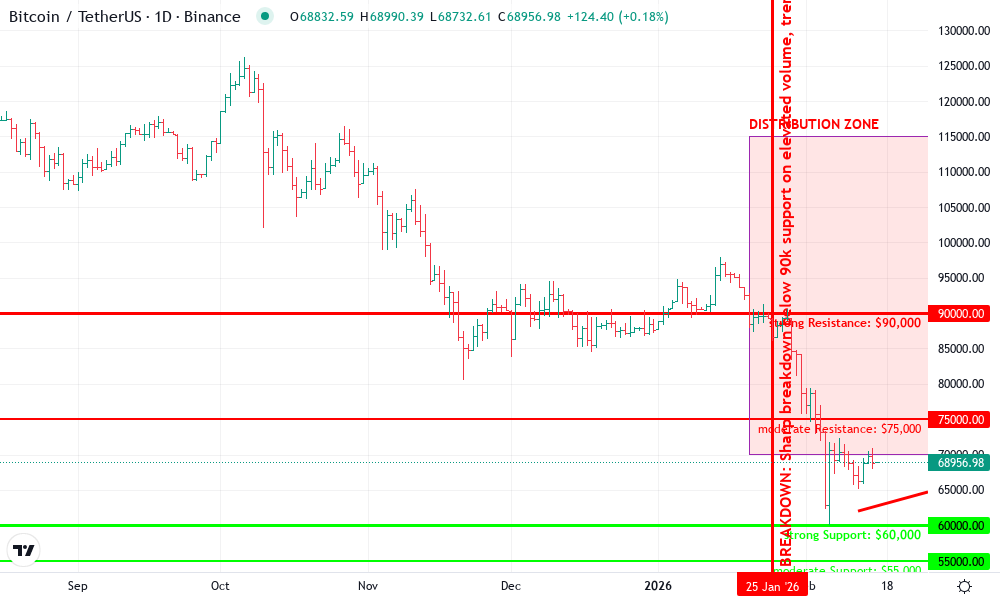
Analysis by Robert Taylor | Symbol: BINANCE:BTCUSDT | Interval: 1D | Drawings: 8
Technical Analysis Summary
On this BTCUSDT daily chart spanning October 2026 to mid-February 2026, draw a prominent downtrend line from the December peak at approximately 118,500 connecting to the recent lows around 62,000 in early February, using 'trend_line' with red color for bearish bias. Add horizontal support at 60,000 (strong, multi-touch low), resistance at 75,000 (recent rejection). Mark the sharp breakdown candle in late January with 'vertical_line' and 'arrow_mark_down'. Use 'rectangle' for the consolidation range post-drop from 68,000-72,000 in early February. Fib retracement from peak to low (23.6% at ~85,000, 50% at ~90,250). Volume spikes on downside warrant 'callout' annotations. Entry zone only on confirmed support bounce with tight stops, per low-risk hybrid approach.
Risk Assessment: high
Analysis: Elevated volatility from peak-to-trough 50% drawdown, bearish momentum intact, low conviction bounce signals amid crypto compliance uncertainties
Robert Taylor's Recommendation: Stay sidelined 'risk off' until support holds with multi-TF confirmation; preserve capital for verified setups—compliance on.
Key Support & Resistance Levels
📈 Support Levels:
- $60,000 - Strong multi-week low with volume cluster, potential accumulation base strong
- $55,000 - Psychological and prior swing low extension moderate
📉 Resistance Levels:
- $75,000 - Recent swing high rejection post-drop moderate
- $90,000 - 50% fib retracement of decline, prior consolidation lid strong
Trading Zones (low risk tolerance)
🎯 Entry Zones:
- $61,500 - Bounce from strong support with volume confirmation, low-risk long if MACD diverges bullish low risk
- $72,000 - Short entry on resistance retest failure, but only with tight stops given volatility medium risk
🚪 Exit Zones:
- $68,000 - Initial profit target on pullback resistance 💰 profit target
- $59,000 - Stop loss below key support to limit downside 🛡️ stop loss
Technical Indicators Analysis
📊 Volume Analysis:
Pattern: spike on downside with declining on bounce
Bearish volume confirmation on breakdown, low volume in consolidation signals weak buying
📈 MACD Analysis:
Signal: bearish crossover with expanding histogram
MACD below zero line, momentum favors sellers; watch for bullish divergence at lows
Applied TradingView Drawing Utilities
This chart analysis utilizes the following professional drawing tools:
Disclaimer: This technical analysis by Robert Taylor is for educational purposes only and should not be considered as financial advice. Trading involves risk, and you should always do your own research before making investment decisions. Past performance does not guarantee future results. The analysis reflects the author's personal methodology and risk tolerance (low).
Cysic Partnership: Compute Meets Verifiability
Inference Labs' collaboration with Cysic launches scalable infrastructure blending decentralized ASIC-powered compute with zkML frameworks. This duo confronts performance and cost barriers, targeting verifiable autonomous agents and oracles. Accountability via proofs ensures transparency, vital as AI integrates deeper into DeFi and DAOs. EigenLayer's security backbone amplifies this, pooling restaked ETH for robust AVSs.
Read more on how verifiable inference builds trust in decentralized AI compute networks. Such partnerships mitigate single-point failures, diversifying risk in inference portfolios. Still, integration complexities loom; monitor for seamless execution before full commitment.
From a risk perspective, this Cysic tie-up diversifies compute sources, blending ASICs with zkML proofs to stabilize inference costs amid volatile crypto markets. Yet, execution risks persist; ASIC centralization could undermine decentralization ideals if not balanced carefully. Investors should track on-chain metrics like proof verification rates before scaling positions.
Competitive Landscape: zkML's Expanding Frontier
Inference Labs zkML innovations shine, but the field buzzes with rivals sharpening their edges. Modulus Labs pushes on-chain proofs for models up to 18 million parameters, while Lagrange's DeepProve boasts 158x faster verifications, challenging DSperse's gains. Kudelski Security notes zkML's blend of zero-knowledge proofs with machine learning as nascent, prone to proof size explosions for complex nets. Equilibrium's state-of-verifiable-inference report stresses proving model integrity without leaks, a bar Inference Labs clears admirably.
These players fuel decentralized inference markets 2026, tokenizing compute and proofs into tradeable assets. I advise hybrid analysis: blend TVL growth in EigenLayer AVSs with proof throughput. Over-reliance on one protocol invites tail risks; diversify across ZK-VIN, DeepProve, and emerging FHE fusions like those eyed by BlockEden.
Adoption Metrics: From Proofs to Production Scale
Concrete numbers underscore momentum. Inference Labs hit 281 million zkML proofs by August 2025, a testament to DSperse's prowess in slashing memory to under 1GB. This enables verifiable AI blockchain apps like tamper-proof oracles feeding DeFi with AI signals. Partnerships amplify reach; Cysic's ASIC muscle pairs with proofs for agents that self-audit decisions on-chain.
Comparison of zkML Frameworks
| Project | Proof Speed Gain | Memory Usage | Max Parameters Supported | Proofs Processed |
|---|---|---|---|---|
| Inference Labs DSperse | 65% | <1GB | scalable large models | 281M |
| Lagrange DeepProve | 158x faster | N/A | N/A | emerging |
| Modulus Labs | N/A | efficient on-chain | 18M | N/A |
Proof volumes signal network effects kicking in, but watch for saturation. High-throughput proofs could flood AVSs, spiking gas fees during bull runs. Portfolio hedgers, consider options on inference tokens tied to EigenLayer restaking yields; they buffer against proof inflation.
Looking ahead, zkML proofs fortify on-chain AI proofs against adversarial attacks, where tampered inputs plague centralized setups. Inference Labs' trajectory, from ZK-VIN to DSperse, positions them as frontrunners, yet the space demands vigilance. Equilibrium hints at future directions like hybrid ZK-FHE for ultra-private inference, potentially unlocking trillion-parameter models in decentralized ecosystems.
For those navigating these waters, my mantra holds: risk management turns traders into survivors. Stake compute judiciously, verify proofs rigorously, and hedge against tech pivots. As decentralized AI inference matures, those blending caution with conviction will thrive in this proof-powered paradigm.




No comments yet. Be the first to share your thoughts!