

In the wild world of decentralized AI inference markets, where compute power is tokenized and traded like hot crypto potatoes, verifiability has always been the thorn in everyone's side. Full zero-knowledge proofs for entire ML models? Computationally brutal, cost-prohibitive, and a scalability nightmare. Enter DSperse from Inference Labs - a game-changer in targeted ZK proofs for ML that lets you verify just the juicy bits without proving the whole pie. As someone who's swung trades on inference tokens for years, I've seen plenty of hype fizzle out, but DSperse's slice-based approach feels like the real deal for scalable ML inference markets.
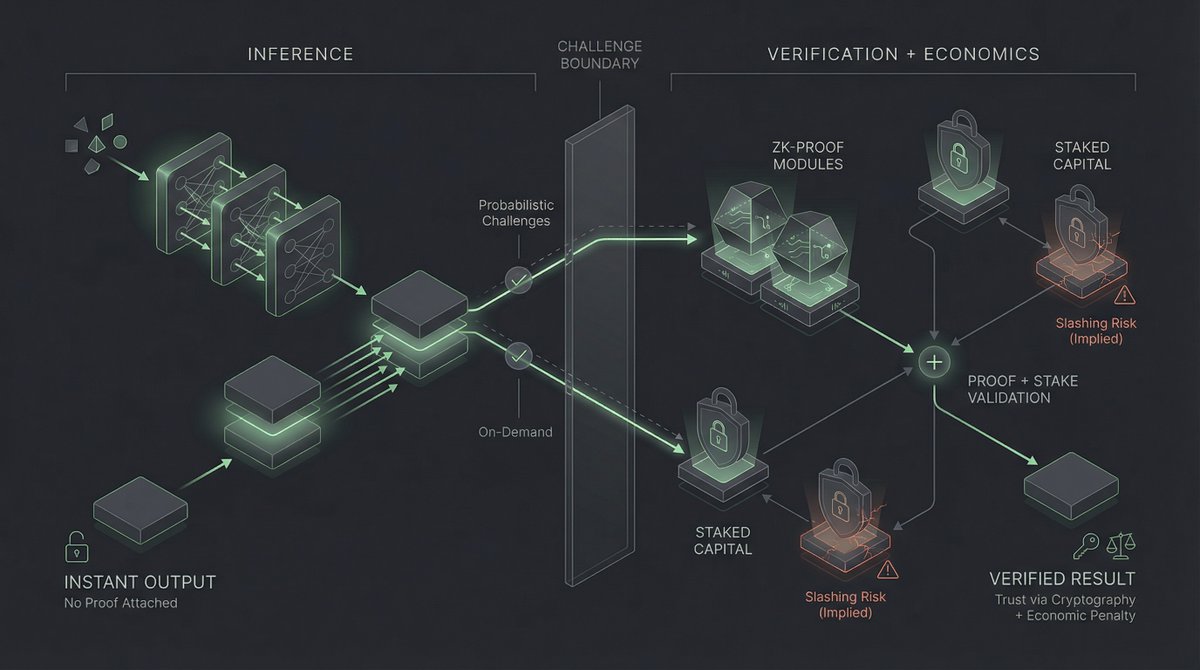
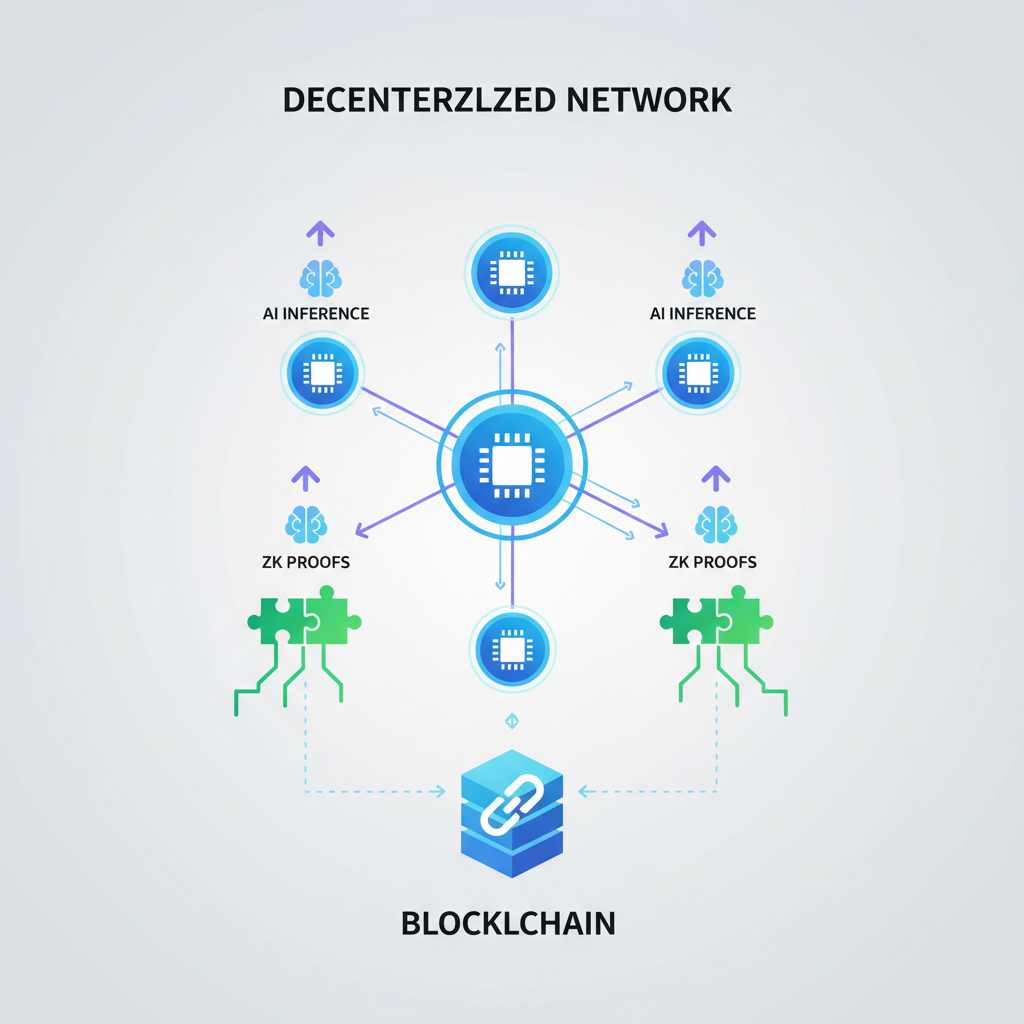
Picture this: massive language models churning through inferences on a global network of provers, but only the critical layers - say, the final output or high-risk computations - get wrapped in ZK circuits. The rest? Distributed freely, slashing costs by orders of magnitude while keeping trust intact. That's DSperse Inference Labs magic, turning what was once a pipe dream into practical infrastructure for zero-knowledge decentralized inference.
Why Full-Model ZK Proofs Fall Flat in Real Markets
Let's cut the fluff. Traditional zkML demands proving every matrix multiplication and activation function from input to output. For a 7B parameter model, that's gigabytes of proof data and hours of prover time - not viable when you're paying per inference in a competitive market. I've traded tokens from projects trying this brute-force method; they pump on announcements but dump on gas fees. DSperse flips the script with decentralized AI inference verification that's selective and strategic.
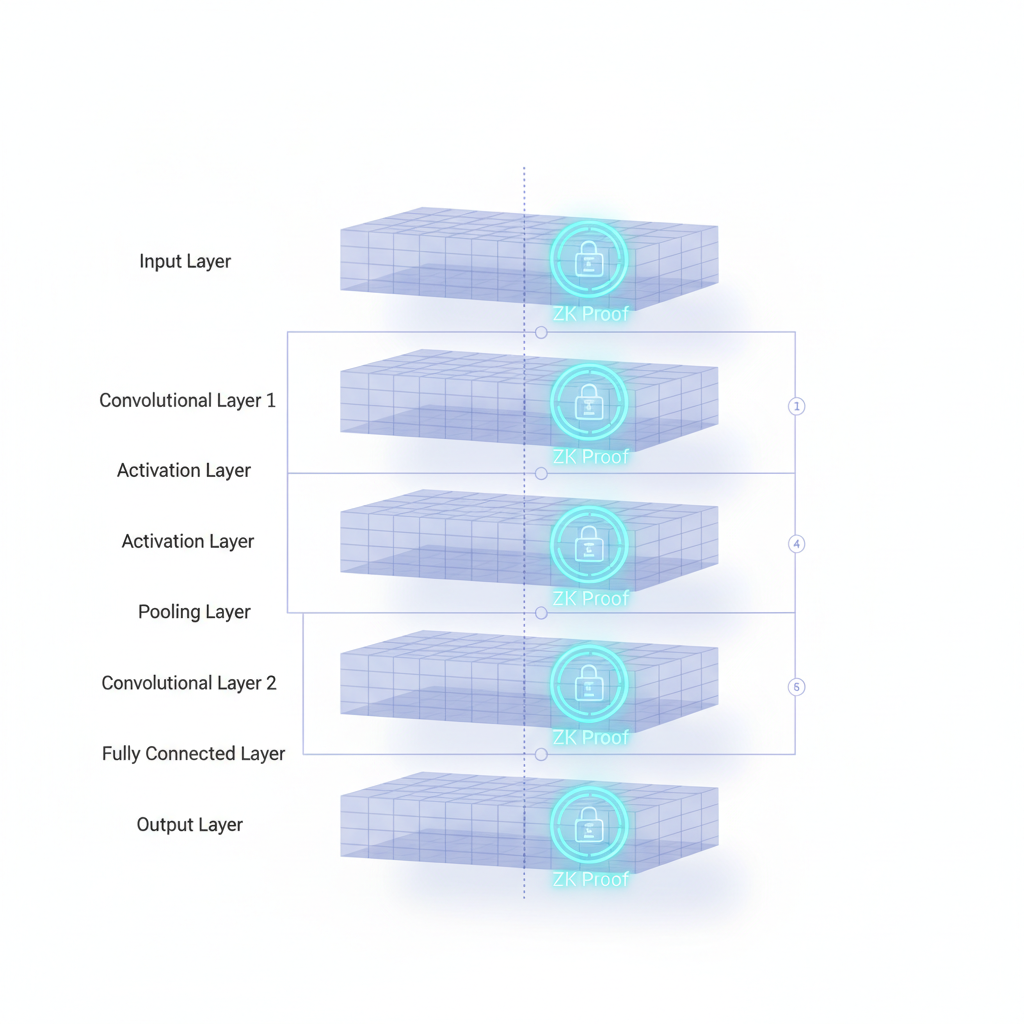
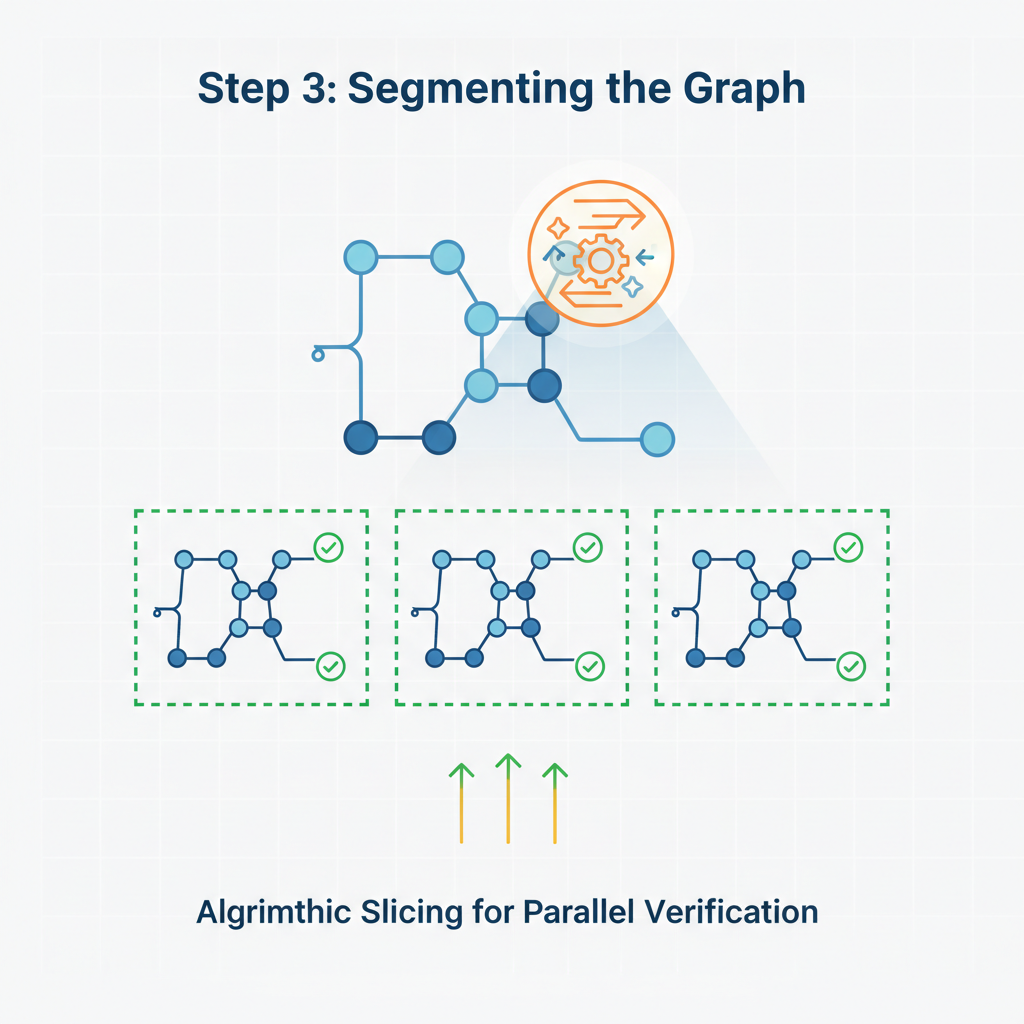
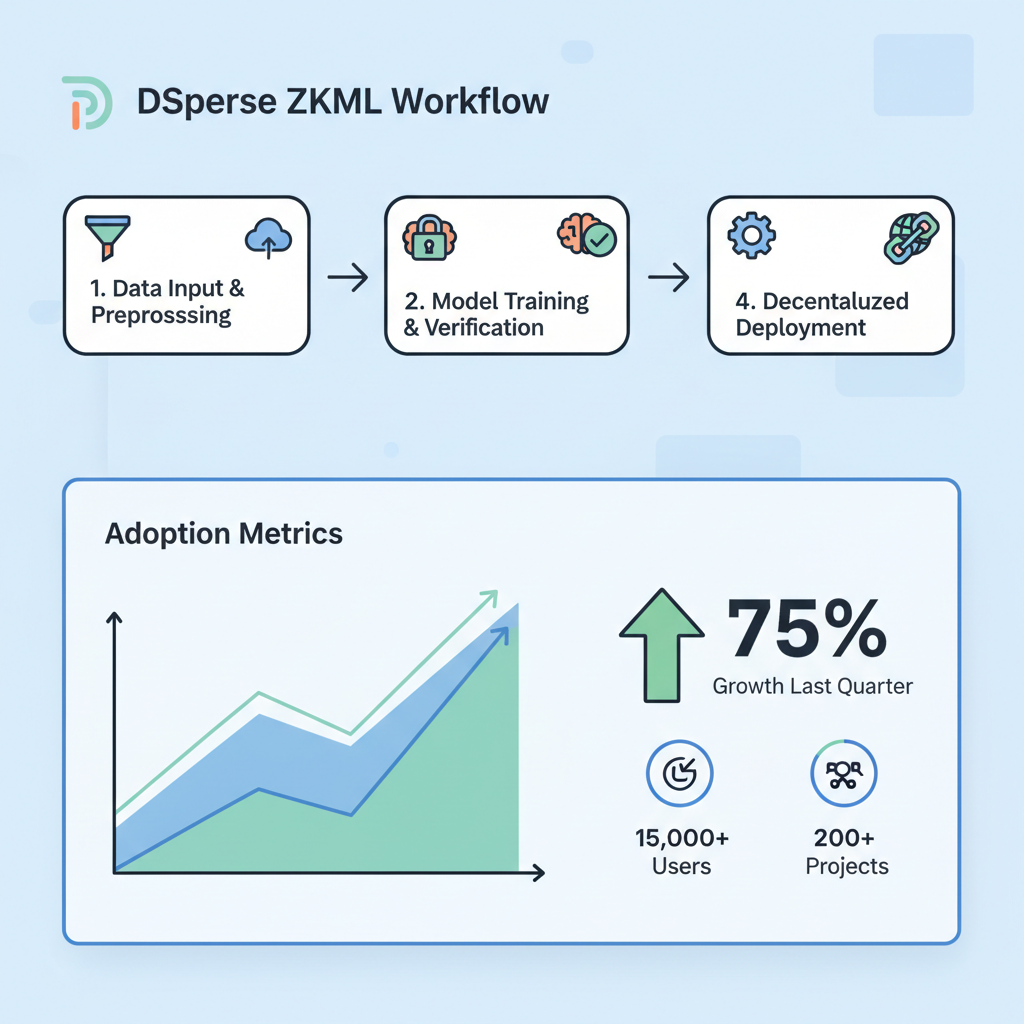
By analyzing ONNX models, DSperse identifies natural breakpoints aligned with the model's logic - think layer boundaries or computation slices. Only those get the ZK treatment, enabling parallel execution across decentralized nodes. Provers handle slices independently, aggregate proofs on-chain, and voila: verifiable results at a fraction of the cost. It's not just theory; their modular framework supports custom verification boundaries, making it adaptable to any model architecture.
Slicing Strategy: The Core of DSperse Efficiency
Digging deeper, DSperse's targeted verification shines in how it optimizes proof boundaries. Instead of rigid full proofs, it lets developers specify which slices matter most - perhaps the attention heads in a transformer or the softmax in classification. This flexibility is gold for targeted ZK proofs ML applications, from agentic AI verifying actions to DeFi oracles confirming predictions.
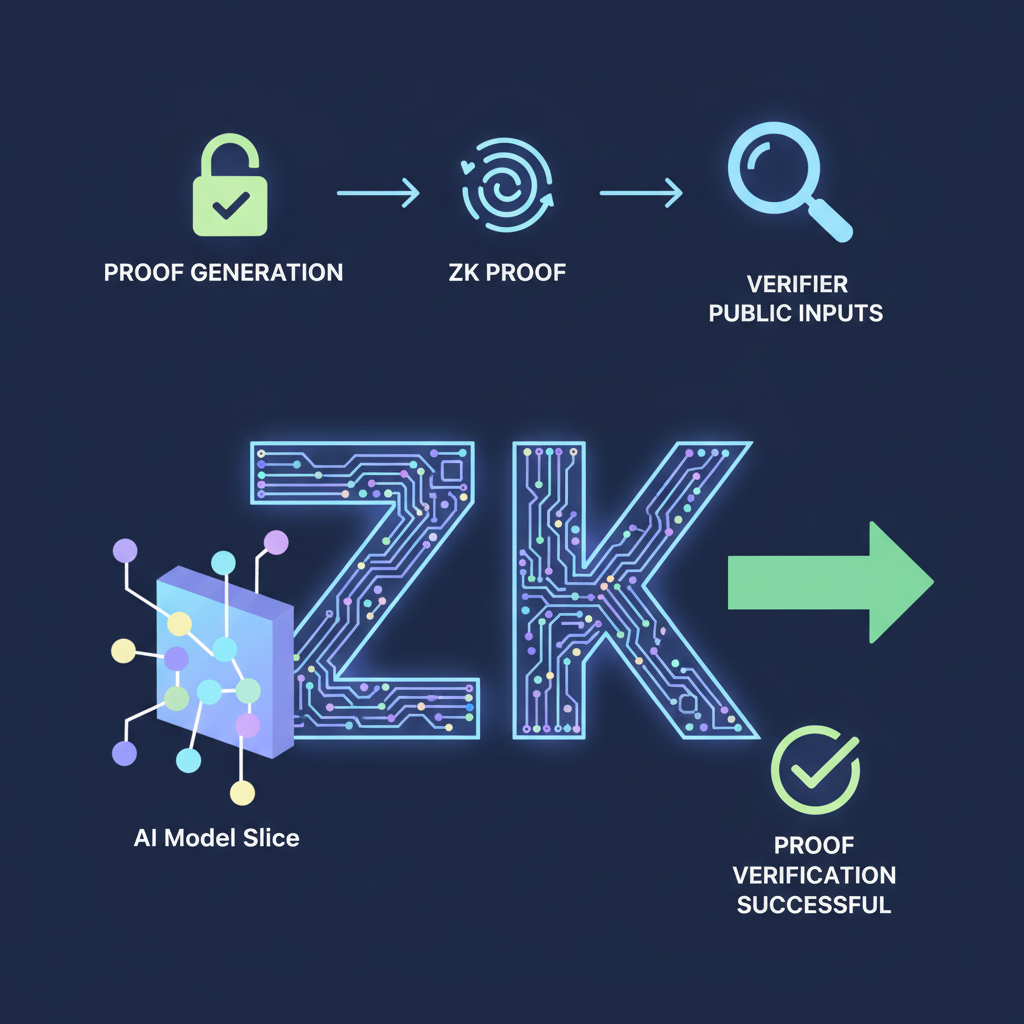
In practice, the framework converts select ONNX segments into circuits using tools like Halo2 or Gnark, then distributes proving tasks. Results? Parallelism that scales with network size, reducing latency from minutes to seconds. As a trader eyeing inference market caps, I see this as a multiplier for token utility - more inferences per block means higher throughput, juicier yields for stakers.
Inference Labs didn't stop at design; they've baked DSperse into their Proof of Inference protocol. On testnet, it's cranked out over 160 million ZK proofs, stress-testing the system for mainnet in late Q3 2026. That's not vaporware - that's battle-hardened code ready to disrupt centralized inference giants.
Unlock DSperse: Your Guide to ZKML-Powered Decentralized AI Inference
Funding Firepower and Testnet Momentum Building Trust
Backing this tech beast is $6.3 million from heavyweights like Delphi Ventures and Mechanism Capital. Smart money betting on DSperse to cornerstone decentralized AI inference verification. Why? Because in a world of AI agents swarming blockchains, you can't afford unproven executions. DSperse makes verification infrastructure-grade, proving model runs and agent behaviors without bloating costs.
From my swing trading lens, projects with proven testnet metrics like these rarely disappoint. Inference Labs leverages EigenLayer for security, creating a ZK Verified Inference Network that's on-chain reliable. As agent ecosystems explode, DSperse positions provers as essential nodes, tokenizing compute in ways that could spark the next inference token rally.
Tokenizing this verification edge could ignite yields for stakers and provers alike. Picture Inference Labs' network where DSperse slices fuel a marketplace of proofs, traded seamlessly on-chain. That's the kind of utility that turns early positions into multi-baggers, if you time the swings right.
Swing Trading Signals in the DSperse Era
From my seven years dissecting decentralized AI inference markets, momentum indicators scream opportunity here. DSperse isn't just tech; it's a catalyst for token velocity. Watch for RSI divergences on 5-day charts as testnet metrics roll in, signaling entries before mainnet hype. I've nailed similar setups in volatile DeAI plays - enter on pullbacks to 20-day EMAs, exit at prior highs with tight stops. Discipline is key; FOMO kills more swings than bad code.
Bittensor Technical Analysis Chart
Analysis by Lisa Anderson | Symbol: BINANCE:TAOUSDT | Interval: 4h | Drawings: 8
Technical Analysis Summary
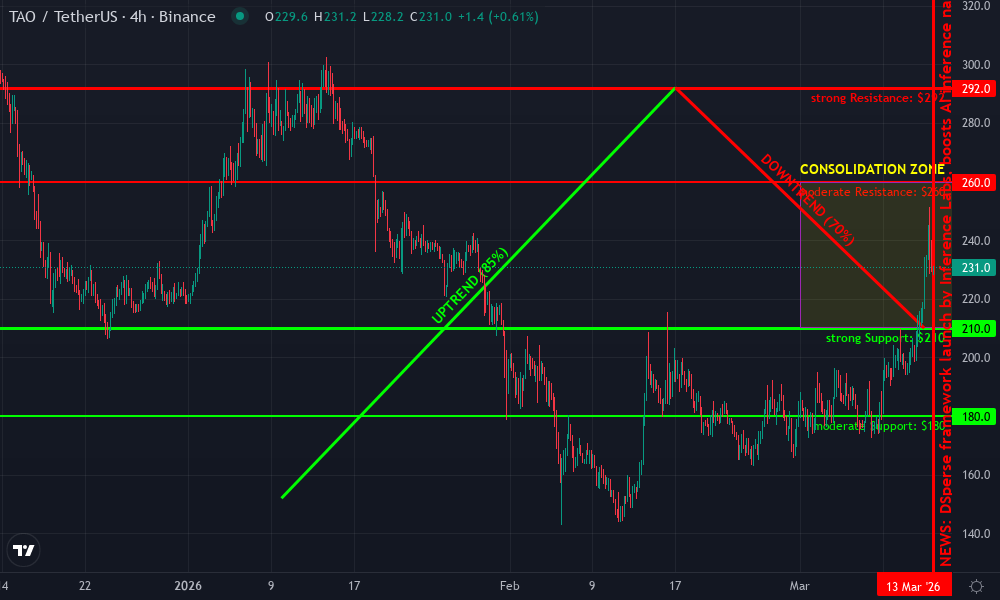
In my balanced swing-trading style, start by drawing a primary uptrend line connecting the January 2026 low at around 150 to the February peak near 290, then overlay a short-term downtrend channel from the February high to the recent March pullback low at 210. Add horizontal support at 210 and resistance at 260/290. Mark entry zone near 220 with a long_position rectangle, profit target at 280 via order_line, and stop-loss at 200. Use fib_retracement from Feb high to March low for 50-61.8% levels. Highlight consolidation rectangle mid-March 210-260. Vertical line for DSperse news impact on 2026-03-13. Callouts for volume spikes and MACD bullish cross.
Risk Assessment: medium
Analysis: Uptrend intact but recent pullback adds volatility; DSperse catalyst positive yet unproven in price action
Lisa Anderson's Recommendation: Enter long swings targeting 280, trail stops; monitor IVMS101 compliance news for crypto-wide impact
Key Support & Resistance Levels
📈 Support Levels:
- $210 - Recent swing low with volume support, strong retest strong
- $180 - Prior consolidation base from late Jan moderate
📉 Resistance Levels:
- $260 - 50% fib retrace and recent high moderate
- $292 - Feb all-time high in this period strong
Trading Zones (medium risk tolerance)
🎯 Entry Zones:
- $222 - Bounce off 210 support with MACD bull cross, aligns with uptrend medium risk
🚪 Exit Zones:
- $280 - Measured move from pullback low, near 61.8% fib extension 💰 profit target
- $200 - Below 210 support invalidates setup 🛡️ stop loss
Technical Indicators Analysis
📊 Volume Analysis:
Pattern: increasing on reversal candles
Volume spike on March rebound confirms buyer conviction post-DSperse news
📈 MACD Analysis:
Signal: bullish crossover
MACD line crossing signal from below mid-March, momentum shift
Applied TradingView Drawing Utilities
This chart analysis utilizes the following professional drawing tools:
Disclaimer: This technical analysis by Lisa Anderson is for educational purposes only and should not be considered as financial advice. Trading involves risk, and you should always do your own research before making investment decisions. Past performance does not guarantee future results. The analysis reflects the author's personal methodology and risk tolerance (medium).
The chart above lays it out: as DSperse Inference Labs milestones hit, sector betas amplify. Provers earning from slice verification create sticky demand, pushing tokens past resistance. Pair this with EigenLayer restaking for compounded APYs, and you've got a setup primed for 2-3x rotations in bull cycles. But remember, inference markets swing hard - volatility is the tax on outsized gains.
Scalability wins like DSperse's slice strategy ripple beyond Inference Labs. Imagine DeFi protocols verifying oracle feeds or NFT generators proving rarity computations via targeted ZK proofs ML. This modularity lets smaller teams compete, fragmenting the centralized inference duopoly and democratizing AI compute. Provers bid on slices, models evolve modularly, markets price risk per layer. Chaos? Nah, that's evolution toward truly scalable ML inference markets.
Proof Aggregation: Gluing Slices into Trustworthy Outputs
One underrated gem: DSperse's aggregation layer. Slices prove independently, but outputs chain via recursive proofs or Merkle trees, ensuring end-to-end integrity without recomputing everything. This handles model updates seamlessly - tweak a layer, re-prove just that slice. For traders, it means protocol upgrades won't tank uptime, stabilizing token floors during dev sprints.
Real-world stress tests on testnet, with 160 million proofs generated, validate this. Latency drops, costs plummet 10-50x versus full proofs, per arXiv benchmarks. That's not incremental; it's a paradigm shift for zero-knowledge decentralized inference, where verification scales linearly with compute, not quadratically.
Zoom out to agent swarms: autonomous bots executing trades, generating content, optimizing yields. Without DSperse-grade verification, they're black boxes ripe for exploits. With it, every action proves faithful to the model, slashing dispute resolution and unlocking trillion-dollar agent economies. Inference Labs, powered by $6.3 million war chest, leads this charge, but watch for forks and competitors iterating on the slice model.
Verification becomes infrastructure as agent ecosystems grow. DSperse proves it.
Optimism aside, risks lurk. ZK circuit compilation for novel architectures could bottleneck adoption, and prover centralization if rewards skew big iron. Yet, Inference Labs' open-source push and EigenLayer AVS integration mitigate these. From a trading perch, dips on FUD are buy zones - momentum favors builders shipping verifiable scale.
DSperse redefines the inference game, blending crypto primitives with ML pragmatism. Provers thrive, developers iterate faster, markets hum with tokenized trust. Stake your claim in this verifiable frontier; the swings ahead reward the prepared.




No comments yet. Be the first to share your thoughts!