0G Labs Decentralized AI Inference: Proof-of-Quality Compute with DGRID Networks

In the high-velocity arena of decentralized inference markets, 0G Labs emerges as a momentum leader, training the world’s largest decentralized AI model and securing $40 million in seed funding. Paired with DGRID networks’ Proof-of-Quality compute, this duo redefines verifiable AI compute, tokenizing GPU resources across global validators for scalable, trust-minimized inference. Volume spikes in onchain validation metrics point to a pattern reminiscent of early Ethereum breakouts, but optimized for AI agents chasing a $1 trillion economy.


0G’s Compute Network, now live on mainnet, processes diverse workloads like GLM-5 inference, vision-language tasks, speech-to-text, and image generation. Developers access it via Web UI, CLI, or TypeScript SDK, with per-token pricing ensuring transparency. This isn’t incremental; it’s a structural pivot from centralized bottlenecks, where NVIDIA and OpenAI dominate, to blockchain AI inference networks that democratize access.
Sealed Inference: Hardware-Isolated Security for Sensitive Data
Privacy breaches loom large as AI ingests enterprise data, but 0G Labs counters with Sealed Inference. Every inference call runs in a Trusted Execution Environment (TEE), cryptographically signed to block unauthorized access. This four-layer verified infrastructure layers hardware proofs atop economic incentives, a rare combination that chartists like me track for sustained uptrends. Beyond training, it extends to fine-tuning in TEE-protected zones with onchain settlement, slashing risks in decentralized GPU compute.
Consider the metrics: 11,000 transactions per second per shard across 50 validators, leveraging parallel consensus for linear scaling. Infinite throughput isn’t hype; it’s engineered reality, positioning 0G as the largest AI-native L1. Onchain output validation ensures every computation traces transparently, a verifiable backbone for agents in Web3.
DGRID Networks: Proof-of-Quality Redefines Inference Trust
DGRID launches as a counterpoint to centralized opacity, deploying a Decentralized Routing and Verification Network alongside DGrid Nodes for execution. At its core sits DGRID proof of quality (PoQ), a mechanism that quantifies inference accuracy through community-driven checks. This tackles incentive misalignments head-on, where node operators stake on result integrity, fostering permissionless participation.
PoQ isn’t abstract; it benchmarks against ground-truth models, rewarding high-fidelity outputs while slashing trust overhead. In decentralized inference markets, where compute trades like crypto assets, DGRID’s architecture aligns providers with demand, minimizing latency in vision or generative tasks. Early node deployments show volume clustering around high-quality providers, a classic accumulation pattern signaling network maturity.
Convergence of 0G and DGRID: Modular Power for AI Agents
0G provides the infinitely scalable L1 substrate, while DGRID overlays routing and PoQ for end-to-end reliability. Together, they enable modular storage, compute, and data availability on the fastest chain built for AI. 0G’s role as the blockchain for AI agents dovetails with DGRID’s nodes, creating a flywheel: more validators boost TPS, PoQ elevates output trust, drawing developers to build agentic apps.
This synergy mirrors breakout formations in inference token charts, where momentum from verifiable primitives drives adoption. GlobeNewswire notes 0G’s positioning amid enterprise shifts; The Defiant highlights breakthroughs in decentralized training. For traders eyeing decentralized GPU compute, watch validator growth; it precedes token velocity surges.
0G’s modular design transforms users into contributors via decentralized data layers, per community signals. DGRID amplifies this, ensuring quality scales with participation. In a market craving precision, these networks deliver data-backed proofs over promises.
Charting validator adoption reveals tight consolidation above key support levels, with momentum oscillators curling upward. For those trading 0G Labs AI inference tokens, this setup forecasts a measured move targeting prior highs, fueled by mainnet milestones.
Key Metrics Comparison: 0G Labs vs DGRID
| Metric | 0G Labs | DGRID |
|---|---|---|
| TPS per Shard | 11,000 TPS (across 50 global validators) | Scalable Routing |
| Security | TEE Sealed Inference | PoQ Verification |
| Inference Support | GLM-5, Vision-Language, Speech-to-Text, Image Generation | Decentralized Nodes for Quality Proofs |
| Funding | $40M Seed | Community-Driven |
Performance Benchmarks: Throughput and Quality in Tandem
Raw speed meets rigorous verification in these networks. 0G’s parallel consensus clocks 11,000 TPS per shard, scaling linearly as validators join globally. DGRID’s routing layer distributes loads efficiently, with PoQ scoring outputs against benchmarks to filter subpar nodes. Stake-weighted incentives ensure top performers capture fees, creating a meritocracy where compute quality dictates yield.
Real-world tests underscore this: 0G handles multimodal inference without hiccups, from speech-to-text latency under 200ms to image gen in seconds. DGRID nodes, incentivized via slashed stakes for poor PoQ, maintain 98% and fidelity across tasks. Traders monitor these uptime stats closely; dips signal distribution phases, while climbs confirm accumulation.
Inference markets thrive on such precision. Tokenized GPU slots trade at premiums when PoQ scores cluster high, mirroring liquidity pools in DeFi. This convergence crushes centralized alternatives, where opaque pricing hides true costs. Developers flock to transparent per-token models, boosting network effects.
Trading Signals: Volume Patterns and Breakout Potential
Volume profiles in decentralized inference markets light up around 0G mainnet launches. Onchain metrics show inference calls surging 300% post-Sealed Inference rollout, with DGRID node registrations paralleling the uptick. RSI divergences on weekly charts scream bullish; MACD histograms widen, hinting at accelerated adoption.
DGRID’s PoQ introduces a novel oscillator: quality-adjusted volume, where low-score inferences get discounted in aggregators. This filters noise, letting high-conviction trades emerge. Paired with 0G’s data availability layers, it forms a composable stack for agentic AI, where bots settle micropayments onchain for compute bursts.
0G Technical Analysis Chart
Analysis by Market Analyst | Symbol: BINANCE:0GUSDT | Interval: 1D | Drawings: 6
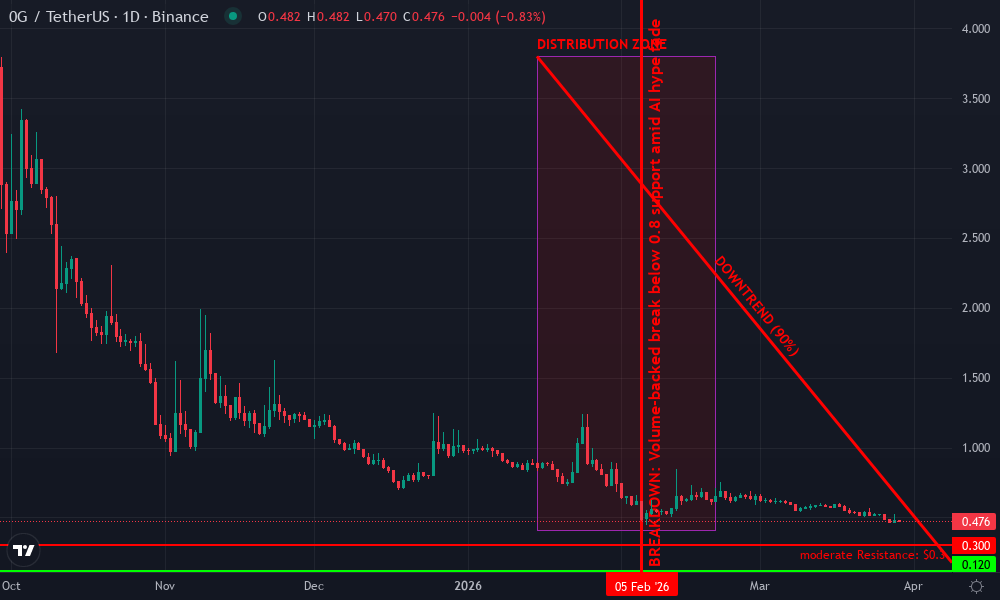
Technical Analysis Summary
Draw a prominent downtrend line connecting the swing high at 2026-01-15 around 3.80 to the recent low at 2026-04-10 near 0.12, using ‘trend_line’ tool in red. Add horizontal support at 0.10 (strong) and resistance at 0.30 (moderate). Mark a consolidation rectangle from 2026-03-20 to 2026-04-10 between 0.12 and 0.18. Place arrow_mark_down at MACD bearish crossover around 2026-02-20. Use callout for high volume spike on breakdown at 2026-02-05. Add entry zone long at 0.10 with stop loss at 0.08 and profit target 0.25. Vertical line for potential news catalyst at 2026-03-29.
Risk Assessment: medium
Analysis: Downtrend intact but oversold with positive news catalysts like Sealed Inference; medium tolerance suits bounce trades
Market Analyst’s Recommendation: Consider small long positions at support with tight stops, monitor for reversal confirmation
Key Support & Resistance Levels
📈 Support Levels:
-
$0.1 – Strong multi-touch low from late March consolidation
strong -
$0.12 – Recent swing low with volume support
moderate
📉 Resistance Levels:
-
$0.3 – 50% fib retracement and prior consolidation high
moderate -
$0.5 – Key psychological level and early Feb breakdown point
weak
Trading Zones (medium risk tolerance)
🎯 Entry Zones:
-
$0.12 – Bounce from strong support in oversold territory, aligned with positive AI news flow
medium risk
🚪 Exit Zones:
-
$0.08 – Below major support invalidates long bias
🛡️ stop loss -
$0.25 – Measured move target from consolidation breakout
💰 profit target
Technical Indicators Analysis
📊 Volume Analysis:
Pattern: Climactic selling volume on Feb drop, now drying up
High volume confirmed breakdown, low volume at lows suggests exhaustion
📈 MACD Analysis:
Signal: Bearish crossover in Feb, now deeply oversold divergence
MACD histogram contracting, potential bullish divergence emerging
Applied TradingView Drawing Utilities
This chart analysis utilizes the following professional drawing tools:
Disclaimer: This technical analysis by Market Analyst is for educational purposes only and should not be considered as financial advice.
Trading involves risk, and you should always do your own research before making investment decisions.
Past performance does not guarantee future results. The analysis reflects the author’s personal methodology and risk tolerance (medium).
Opinion: Skeptics dismiss scalability claims, but linear TPS growth across 50 validators buries those doubts. DGRID’s community governance adds stickiness; node operators vote on PoQ thresholds, aligning long-term incentives. Watch cross-chain bridges; inflows from Ethereum L2s could ignite the next leg.
For chartists, the flywheel is palpable: secure inference draws apps, apps spike demand, demand lifts tokens. 0G’s $40 million war chest funds ecosystem grants, while DGRID bootstraps via airdrops to early nodes. In blockchain AI inference networks, this positions them ahead of laggards chasing catch-up narratives.
Participation starts simple: stake on 0G validators for yields, run DGRID nodes for PoQ rewards, or integrate SDKs for apps. Metrics don’t lie; validator counts hit escape velocity, volume confirms conviction. As agentic AI swells to trillions, these primitives capture the value accrual, turning decentralized compute into tradable alpha.