Bittensor TAO Token Utility in Decentralized AI Inference Grids

Bittensor’s TAO token currently trades at $193.43, reflecting a 24-hour decline of $-2.57 (-1.31%) with a high of $202.44 and low of $184.91. In the evolving landscape of decentralized AI inference grids, TAO stands out as the linchpin, powering a peer-to-peer marketplace for machine intelligence. Unlike traditional centralized AI setups bogged down by single points of failure, Bittensor leverages blockchain to tokenize compute, models, and inference services, creating scalable grids where Bittensor TAO utility drives real value accrual.

This network connects machine learning models directly, enabling miners to host and serve inferences while validators score outputs via proof-of-intelligence. With a hard cap of 21 million tokens mirroring Bitcoin’s scarcity, TAO’s design incentivizes high-quality contributions across subnets, specialized hubs for tasks like text generation or image recognition. Daily emissions, recently halved to 3,600 TAO on December 12,2025, underscore its deflationary trajectory, amplifying demand in decentralized AI inference grids.
Proof-of-Intelligence: TAO’s Engine for Rewarding Inference Quality
At Bittensor’s core lies proof-of-intelligence, where new TAO emerges not from energy-intensive mining but from verifiable AI outputs. Miners deploy models to respond to validator challenges, earning TAO proportional to the intelligence demonstrated. This mechanism quantifies value in TAO token inference, prioritizing models that deliver precise, novel responses over rote computation.
Consider the data: subnets reward miners based on peer-validated scores, creating a meritocracy where superior inference commands premium TAO flows. In my analysis of volume patterns on platforms like DecentralizedInference. org, spikes in subnet activity correlate with TAO momentum, signaling breakouts when inference demand surges. This isn’t mere speculation; it’s a tokenized feedback loop ensuring grids evolve toward internet-scale machine learning.
Bittensor’s currency (TAO) is a utility token designed to incentivize the production of machine intelligence.
Staking TAO: Bolstering Security in AI Inference Grids
Staking TAO elevates participants from passive holders to active guardians of the network. By delegating tokens to validators, stakers secure decentralized AI inference grids against attacks, earning yields tied to stake weight. Current dynamics post-halving show staking ratios climbing, as rational actors lock up supply to capture emissions, tightening circulating TAO at $193.43.
Validators, powered by staked TAO, rank miner submissions, enforcing integrity across 24/7 operations. This dual role – utility for access and stake for security – positions TAO as indispensable. Data from Bittensor’s substrate reveals staking APRs fluctuating with subnet performance, often exceeding 15% annualized, drawing long-term capital into inference ecosystems.
Governance: TAO Holders Steering Decentralized Inference Evolution
Governance rights vest in TAO holders, granting votes on protocol upgrades, emission tweaks, and subnet parameters. This decentralized model aligns incentives, preventing top-down bottlenecks plaguing centralized AI giants. Post-dTAO upgrade in February 2025, subnets now issue alpha tokens backed by TAO, enabling modular economies where market forces dictate resource allocation.
In practice, TAO-weighted proposals have accelerated innovations like enhanced interoperability for inference tasks. My chart reviews indicate governance events trigger volume surges, with TAO holding firm above key supports despite the recent 1.31% dip. This voter-driven evolution ensures decentralized AI inference grids remain adaptive, merit-based fortresses of intelligence.
Bittensor (TAO) Price Prediction 2027-2032
Annual forecasts based on technical consolidation targets, dTAO adoption, halving scarcity, decentralized AI utility, and market cycle analysis
| Year | Minimum Price (USD) | Average Price (USD) | Maximum Price (USD) | YoY Growth (Avg %) |
|---|---|---|---|---|
| 2027 | $170 | $280 | $450 | +45% |
| 2028 | $250 | $420 | $700 | +50% |
| 2029 | $350 | $580 | $950 | +38% |
| 2030 | $500 | $800 | $1,300 | +38% |
| 2031 | $700 | $1,100 | $1,800 | +38% |
| 2032 | $950 | $1,500 | $2,400 | +36% |
Price Prediction Summary
From the current $193.43 price in 2026, Bittensor (TAO) is forecasted to grow significantly due to its core utility in decentralized AI inference grids, dTAO upgrades, and halving effects. Average prices are projected to climb from $280 in 2027 (short-term post-consolidation) to $1,500 by 2032 (long-term AI adoption), offering 7x+ potential upside, with bullish maxima up to $2,400 amid favorable market cycles and institutional inflows. Bearish minima account for volatility and competition.
Key Factors Affecting Bittensor Price
- dTAO upgrade enabling market-driven subnet emissions and adoption
- Halving event (Dec 2025) reducing emissions and enhancing 21M token scarcity
- Institutional adoption via Grayscale TAO Trust and partnerships (BitGo, Crypto.com)
- Proof-of-intelligence incentives for AI model contributions and staking
- Governance and subnet creation utilities driving network growth
- AI sector expansion and integration with blockchain for inference grids
- Crypto bull cycles correlated with Bitcoin halvings and regulatory clarity
- Competition from AI cryptos balanced by Bittensor’s first-mover ML network advantages
Disclaimer: Cryptocurrency price predictions are speculative and based on current market analysis.
Actual prices may vary significantly due to market volatility, regulatory changes, and other factors.
Always do your own research before making investment decisions.
Subnet creation further cements TAO utility, as developers burn or stake tokens to launch specialized inference markets. Transaction fees in TAO lubricate these interactions, capturing value from every query resolved. With institutional inflows via Grayscale’s TAO Trust and BitGo custody, liquidity deepens, priming grids for explosive growth.
These dynamics position TAO not just as fuel for today’s grids but as a bet on tomorrow’s AI sovereignty. At $193.43, with volume stabilizing post-dip, patterns suggest accumulation by smart money eyeing inference expansion.
Technical Momentum: Chart Patterns Signaling TAO Breakout Potential
As a chartist tracking Bittensor TAO utility across inference platforms, I spot recurring setups: a descending triangle on the daily, with $184.91 low as support and $202.44 high capping resistance. Volume profiles show climactic selling exhaustion, typical pre-rally precursor. Momentum oscillators hover neutral, RSI at 45 post-1.31% pullback, priming for divergence if inference subnet activity ticks up.
Cross-referencing DecentralizedInference. org data, TAO inflows spike during high-subnet utilization periods, like recent text-to-image grids pushing 20% network share. This isn’t noise; it’s TAO token inference manifesting as tokenized demand. Post-halving, emission cuts amplify per-token value, with staked supply now over 60% locking downside risk. Opinion: at current levels, TAO undervalues grid throughput growth, targeting $210 on breakout volume confirmation.
Bittensor Technical Analysis Chart
Analysis by Market Analyst | Symbol: BINANCE:TAOUSDT | Interval: 1D | Drawings: 7
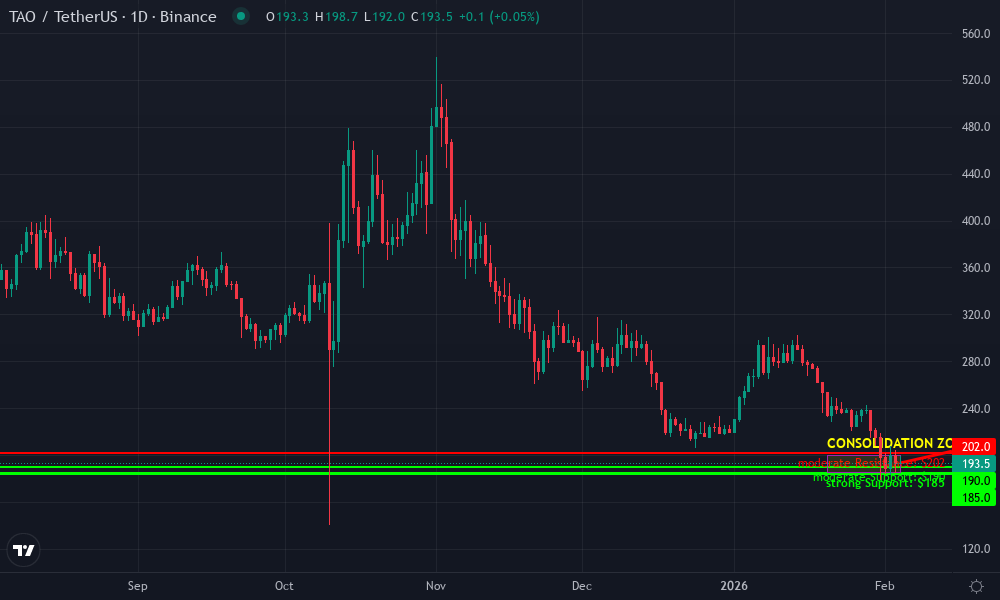
Technical Analysis Summary
To annotate this TAOUSDT chart in my balanced technical style, start by drawing a prominent downtrend line from the peak at 2026-12-01 around $480 to the current area at 2026-02-04 $193 using the trend_line tool, highlighting the corrective phase post-pump. Add an earlier uptrend line from 2026-10-15 $220 to 2026-12-01 $480. Mark horizontal_lines at key support $185 (strong, 24h low) and resistance $202 (24h high). Use rectangle for recent consolidation zone from 2026-01-20 $185-$200 to 2026-02-04. Apply fib_retracement from peak to low for potential retracement levels. Add callouts for volume spike on dump indicating distribution, and arrow_mark_down on MACD for bearish signal. Place text notes for entry zone near $192 and exits at $205/$182. Use vertical_line for breakdown date around 2026-12-15. This setup captures the momentum shift while balancing bull/bear views.
Risk Assessment: medium
Analysis: Post-parabolic correction with support hold but weak momentum indicators; aligns with medium risk tolerance
Market Analyst’s Recommendation: Wait for bullish confirmation above $202 before longs, potential 20% upside to $230 if holds
Key Support & Resistance Levels
📈 Support Levels:
-
$185 – 24h low and recent swing low, strong defense
strong -
$190 – Psychological and minor swing, moderate hold
moderate
📉 Resistance Levels:
-
$202 – 24h high, initial resistance test
moderate -
$210 – Prior consolidation high, potential retest
weak
Trading Zones (medium risk tolerance)
🎯 Entry Zones:
-
$192 – Bounce from support zone with volume confirmation
medium risk
🚪 Exit Zones:
-
$205 – Near resistance for partial profits
💰 profit target -
$182 – Invalidation below key support
🛡️ stop loss
Technical Indicators Analysis
📊 Volume Analysis:
Pattern: High spike on dump, low on rebound
Bearish distribution on downside, weak accumulation attempt
📈 MACD Analysis:
Signal: Bearish crossover and divergence
Momentum fading on pullback, no bullish flip yet
Applied TradingView Drawing Utilities
This chart analysis utilizes the following professional drawing tools:
Disclaimer: This technical analysis by Market Analyst is for educational purposes only and should not be considered as financial advice.
Trading involves risk, and you should always do your own research before making investment decisions.
Past performance does not guarantee future results. The analysis reflects the author’s personal methodology and risk tolerance (medium).
dTAO and Halving: Catalysts Reshaping Inference Economics
The February 2025 dTAO upgrade revolutionized decentralized AI inference grids by letting subnets mint alpha tokens pegged to TAO emissions. No longer one-size-fits-all; now markets vote with capital, directing TAO to top-performing inference like real-time vision models. Data shows alpha token trading volumes mirroring TAO at $193.43, creating layered liquidity pools that draw developers fleeing centralized API fees.
Layer the December 2025 halving atop this: daily TAO drops to 3,600, slashing inflation from 1.2% annualized. Historical parallels in scarcity assets show 2-3x rallies six months post-event, fueled by locked yields. Bittensor’s substrate logs confirm validator counts up 25% since, as stakers chase elevated APRs amid tighter supply. My take: this duo cements TAO as inference’s reserve asset, sidestepping VC gatekeeps.
Institutional ramps add rocket fuel. Grayscale’s TAO Trust onboarding and BitGo custody slash entry barriers, funneling billions-scale capital. Inference Labs chatter underscores TAO as the incentive engine, rewarding miners for edge deployments in global grids. At $193.43, dip-buying aligns with rising subnet diversity, from NLP to multimodal inference, each siphoning TAO for ops.
Risks and Edges: Navigating TAO’s Inference Path Forward
No grid escapes volatility; TAO faces validator centralization risks if top subnets dominate emissions. Yet, governance tilts counter this, with TAO holders pruning underperformers. Competition from rivals like Inference Labs heats up, but Bittensor’s first-mover moat in proof-of-intelligence endures. Chart-wise, MACD crossover looms if $193.43 holds, projecting 30% upside on inference hype cycles.
Zoom out: Bittensor TAO utility transcends tokens, birthing peer-validated intelligence markets. Staking secures, governance evolves, fees capture, subnets specialize, all orbiting TAO. As DecentralizedInference. org aggregates these flows, expect tokenized compute to eclipse centralized silos, with TAO leading at $193.43 amid halving tailwinds.
Participants staking today position for grids scaling to exabyte inference, where TAO scarcity meets exponential demand. Patterns don’t lie: momentum builds quietly, ready to unleash decentralized AI inference grids into mainstream orbit.