
Set up your development environment
Before deploying models on decentralized inference markets, you need a local sandbox that mirrors production constraints. This section walks you through installing the necessary SDKs, configuring a local node, and verifying GPU readiness so your code works before it hits the network.
Once your local environment passes these checks, you are ready to write your first inference script. The next step is to connect this setup to the actual decentralized network.
Connect to the inference network
Before you can submit prompts or run models, your wallet must establish a verified identity on the network. This handshake process ensures that compute providers can validate your account and that your inference requests are routed correctly to available nodes. The connection steps are nearly identical across major decentralized inference protocols like PAI3 and Wavefy, so mastering this flow gives you immediate access to the broader AI compute market.
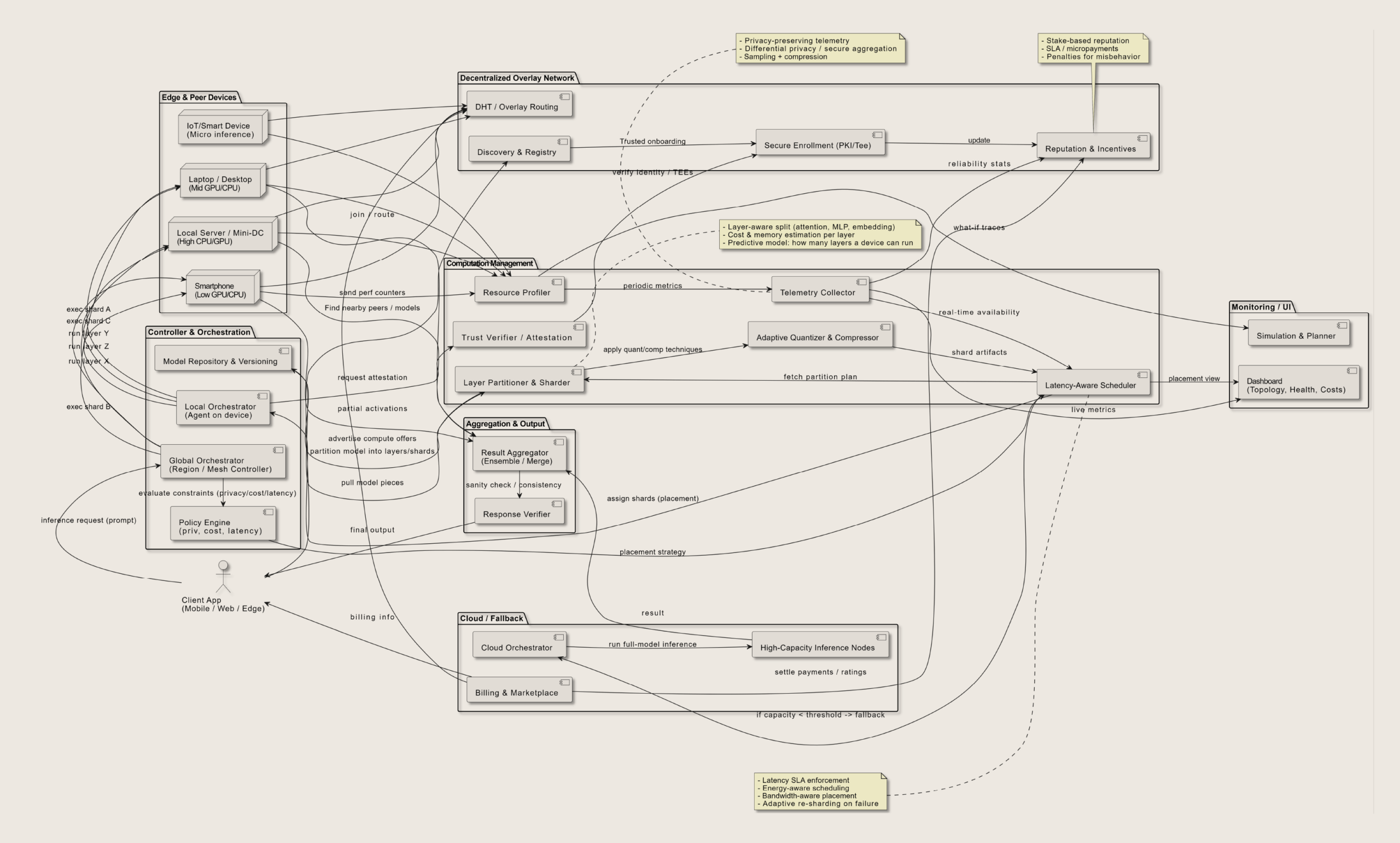
Navigate to the protocol’s official dashboard. Click the "Connect Wallet" button in the top-right corner and select your preferred provider, such as MetaMask or WalletConnect. Authorize the connection in your wallet popup. This step links your on-chain identity to the inference interface, allowing the network to track your usage and rewards.
Once connected, open the network configuration panel. Choose a node based on latency or cost. The dashboard will display real-time availability for different model sizes. Selecting a node closer to your geographic region can reduce inference latency, while selecting a less popular node might offer lower token fees for your queries.
Complete the final handshake by signing a message. The protocol requires a unique cryptographic signature to prove you control the connected wallet. This signature does not cost gas but serves as a lightweight proof of humanity and account ownership. After signing, your status will update to "Connected," and you can begin submitting inference requests.
Submit and verify inference requests
Sending an inference request to a decentralized network requires more than a standard API call. You must structure the payload to match the node’s expected schema and understand how the network routes your data. Once the computation is complete, verifying the result ensures you received a valid output from a trusted node, often backed by cryptographic proofs.
1. Format the request payload
Decentralized inference nodes typically accept JSON payloads containing the prompt, model parameters, and metadata. Unlike centralized APIs, you may need to specify the desired level of privacy or computation type. For example, some networks require you to declare if the inference should be zero-knowledge to ensure compliance and privacy by default.
Always check the node’s documentation for the exact schema. A missing field can cause the request to fail or be routed to a node that cannot handle the specific model version. Use a pre-flight checklist to verify token allowances and latency expectations before sending high-volume requests.
2. Submit to the network
Once formatted, submit the request to the network’s entry point. This could be a specific RPC endpoint or a smart contract interface. The network will then match your request with available nodes based on their capabilities and reputation scores. This matching process is automatic, but you should monitor the transaction hash or request ID to track progress.
3. Verify the inference result
Verification is the core advantage of decentralized inference. When the result returns, you must validate that it was computed correctly by the node. This often involves checking a zero-knowledge proof or a consensus signature attached to the response. If the proof is valid, you can trust the output; if not, the network may reject the result and re-route the request to another node.
This verification step protects you from malicious or low-quality nodes. It ensures that the AI output you receive is accurate and has not been tampered with during transmission or computation.
Optimize for latency and cost
Balancing speed and expense requires choosing the right node infrastructure and model quantization levels. Decentralized inference markets trade off raw throughput for cost efficiency, so your setup must align with your application’s tolerance for delay.
Choose the right node tier
High-performance nodes offer lower latency but come at a premium. Edge nodes are cheaper but may introduce network jitter. Select based on whether your use case prioritizes real-time response or batch processing.
Select model quantization
Quantizing models reduces memory footprint and inference time, often with minimal accuracy loss. Use INT8 or INT4 quantization for large language models to cut costs significantly without sacrificing too much performance.
Compare inference options
| Feature | Centralized Cloud | Decentralized Edge |
|---|---|---|
| Latency | Low (10-50ms) | Higher (50-200ms) |
| Cost | High | Low |
| Scalability | Limited by provider | High (network-dependent) |
| Reliability | High | Variable |
Use this comparison to decide where your inference workload fits best. If latency is critical, stick with centralized providers. If cost is the primary driver, explore decentralized options.
Common deployment mistakes to avoid
Building on decentralized inference markets requires more than just writing smart contracts; it demands operational discipline. The most frequent failure point is ignoring network congestion. Unlike centralized cloud providers with dedicated backbones, decentralized nodes route traffic over public networks where latency spikes are inevitable. If your model doesn’t account for variable round-trip times, inference requests will time out before results return.
Another critical error is failing to implement robust node timeout handling. In a distributed environment, some nodes will always be slower or offline. Your system must detect these failures quickly and redistribute the workload to healthy nodes without blocking the entire pipeline. Hard-coded timeouts that are too short cause unnecessary re-runs, while those that are too long waste resources and frustrate users.
Always test your deployment under simulated network stress. Real-world conditions rarely match local development environments. By prioritizing resilience over raw speed, you ensure your inference service remains reliable even when the underlying network is unstable.
Frequently asked questions about decentralized inference
Understanding the mechanics behind decentralized inference helps clarify how these networks differ from traditional cloud-based AI services. Below are answers to common questions about how the technology works and why it matters for builders.
No comments yet. Be the first to share your thoughts!