
Get decentralized inference markets right
Before you commit capital or integrate a protocol, distinguish the inference layer from the broader decentralized AI ecosystem. Decentralized inference markets coordinate GPU compute for running AI models, whereas prediction markets trade on event outcomes and general AI tokens often govern protocol development. Confusing these segments leads to misaligned risk exposure.
Verify the token’s utility within the compute stack. The most robust projects, such as io.net, Akash, and Render, use tokens to settle node payments and enforce access controls rather than serving as speculative governance proxies. Check if the token is required for staking, node operation, or fee payment. If the token has no direct function in the inference workflow, it likely lacks the fundamental demand drivers of a true compute market.
Assess the node quality and latency guarantees. Inference requires low-latency responses, so prioritize platforms with verified hardware benchmarks and real-time availability metrics. Avoid protocols that rely on unverified node contributions or lack transparent reward distribution mechanisms. A decentralized market is only as reliable as its weakest compute node.
How to participate in decentralized inference markets
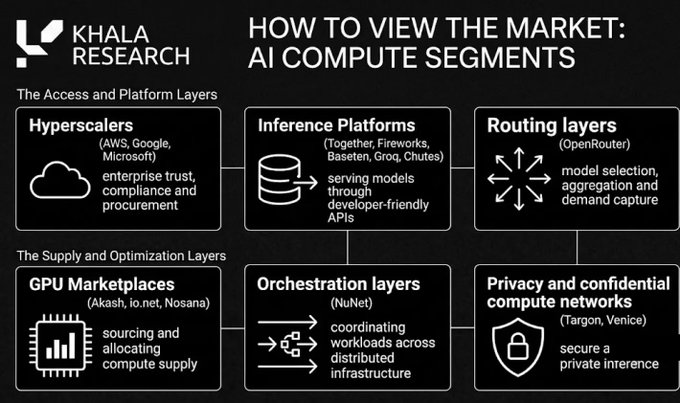
Decentralized inference markets replace centralized cloud providers with peer-to-peer networks of GPU owners. Projects like io.net, Akash, Render, and Nosana coordinate these resources using tokenomics to match compute demand with supply. Participating requires setting up a node, staking tokens, and selecting workloads.
1. Choose a compatible inference network
Not all decentralized compute networks support AI inference. Some focus on storage or general rendering. Review the technical documentation for each project to ensure they support the specific AI models you intend to run or contribute to. Look for networks with active developer communities and established partnerships.
2. Configure your hardware environment
Inference workloads have different requirements than training. Ensure your GPU has sufficient VRAM for the model sizes you plan to serve. Install the necessary drivers and containerization tools like Docker. Test your setup with a lightweight model to verify stability before committing to larger jobs.
3. Stake tokens and register your node
Most networks require a stake in their native token to prove commitment and security. This stake acts as collateral against poor performance or downtime. Register your node on the network dashboard, providing your public IP and hardware specifications. The network will index your capabilities for future job matching.
4. Select and execute inference jobs
Once registered, your node will receive job requests based on its capabilities. Accept jobs that match your hardware profile to minimize latency. Monitor the job status through the network interface. Successful completion earns you token rewards, which are distributed based on the network's consensus mechanism.
5. Verify proofs and claim rewards
After completing a job, the network requires proof of correct execution. This often involves cryptographic signatures or challenger mechanisms where other nodes verify the output. Once verified, your rewards are unlocked. Regularly check your dashboard to claim earnings and reinvest them to increase your node's priority or capacity.
Fix common mistakes
Running decentralized inference requires more than just connecting a GPU to a network. Many users treat these platforms like standard cloud providers, assuming plug-and-play reliability. This approach often leads to failed jobs, lost funds, or poor model performance. The infrastructure is still maturing, and specific pitfalls can derail your workflow before it starts.
Ignoring node latency and proximity
A common error is selecting the cheapest compute node without checking its geographic location relative to your application. Inference is sensitive to latency. If your user-facing app is in New York but your model runs on a node in Tokyo, the round-trip time will make the experience sluggish, regardless of the GPU's raw power.
Always verify the node's region. Many decentralized networks allow you to filter by location or prioritize nodes with lower ping times. The cost savings from a distant node are often outweighed by the poor user experience and potential timeouts.
Overlooking tokenomics and reward stability
Another frequent mistake is ignoring the token mechanics of the compute provider. Some platforms pay node operators in volatile tokens rather than stablecoins. If the token price drops 20% while your job is running, the node operator may have less incentive to keep your instance alive, leading to unexpected termination.
Check the reward distribution model. Prefer platforms that offer stablecoin payments or have strong economic incentives for uptime. Understanding how the node operator gets paid helps you predict their reliability.
Skipping verification and proof checks
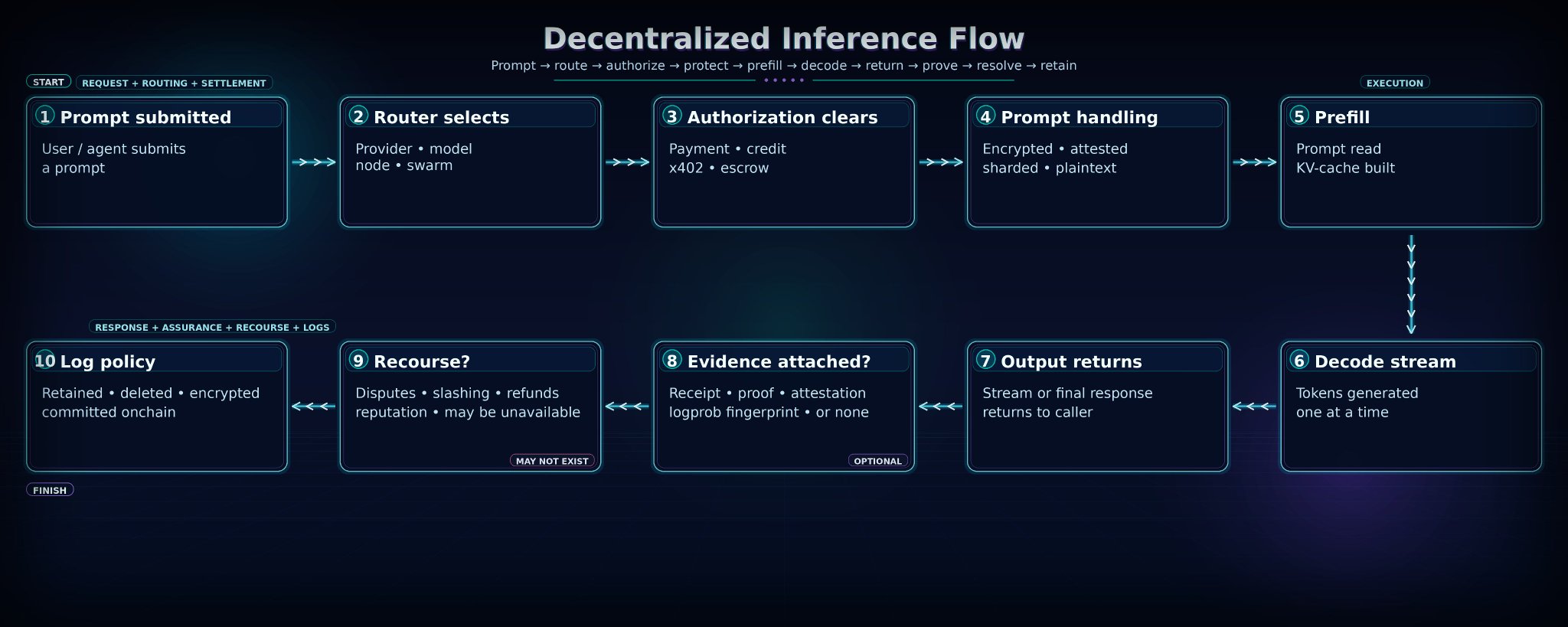
Users often assume that once a job is submitted, the work is done. However, decentralized networks rely on cryptographic proofs to verify that the computation was actually performed. If you don't configure your client to properly request and verify these proofs, you risk paying for incomplete or fake results.
Ensure your inference client is set up to validate the output. This step is critical for trustless execution. Without proper verification, you are essentially sending data to an untrusted party without a receipt.
Decentralized inference markets: what to check next
Before committing capital or compute resources, it helps to separate the infrastructure layer from the financial layer. Decentralized inference markets use blockchain to coordinate GPU supply, but they are not the same as prediction markets or traditional equity investments.
Work through The to Decentralized Inference Markets
No comments yet. Be the first to share your thoughts!