
Why inference needs decentralization
The economics of AI have shifted. In 2026, roughly 70% of GPU compute demand comes from inference, not training [[src-serp-4]]. This volume creates a bottleneck that centralized cloud providers struggle to manage efficiently.
Centralized data centers face high latency and limited burst capacity. Decentralized inference networks distribute this load across a global pool of underutilized GPUs. This structure lowers costs and reduces latency for AI agents that require real-time responses.
The shift is not just technical; it is economic. By spreading compute across a decentralized network, you avoid the single points of failure and pricing volatility inherent in traditional cloud infrastructure.
Choose your network layer
The backbone of decentralized inference 2026 depends on selecting the right infrastructure. You are not just buying compute; you are choosing how your model interacts with the network. The primary options today are general-purpose marketplaces like Akash and specialized AI networks like Bittensor. Each handles cost, latency, and orchestration differently.
Akash operates as a decentralized cloud. It gives you raw access to GPU instances, similar to AWS or GCP, but with lower costs. You manage the container, the dependencies, and the scaling. This approach offers maximum flexibility but requires significant engineering effort. Bittensor, conversely, is a network of miners. You send a prompt, and the network returns an inference result. It is simpler to integrate but offers less control over the underlying hardware or the specific model version running.
The trade-off is clear: flexibility versus simplicity. If you need to run custom, heavy models with specific tuning, Akash is the logical choice. If you need fast, standardized inference for common tasks, Bittensor reduces the overhead. Consider your engineering bandwidth carefully.
Comparison of Infrastructure Options
The table below outlines the practical differences between these two dominant layers. Use this to gauge which fits your current development stage.
| Feature | Akash | Bittensor |
|---|---|---|
| Cost | Low (market-driven GPU rental) | Variable (token-based payment) |
| Latency | Standard cloud latency | Higher (network consensus delays) |
| Orchestration | High (you manage containers) | Low (API-style requests) |
| Flexibility | Full control over model | Limited to network offerings |
As noted in recent industry analysis, decentralized inference on these platforms can beat traditional cloud providers by roughly 30% on cost. However, this saving comes with a hidden tax: engineering time. AWS provides orchestration for free; on Akash, you must build it yourself. Factor these three extra days of setup into your budget before committing to a decentralized path.
Set up verifiable execution
Decentralized inference 2026 relies on a fundamental shift: you must assume the network is hostile. In a centralized cloud, you trust the provider’s hardware. In a decentralized cluster, you verify every computation. Without verification, a malicious node can return garbage results or steal private data. This section covers the steps to implement verifiable execution, ensuring your models remain secure and accurate across untrusted nodes.
1. Select a Verification Protocol
Choose a protocol that fits your latency and budget. VeriLLM is a lightweight framework designed for public verification, offering security with incentive guarantees. It allows any node to verify the correctness of an LLM output without re-running the entire model. Alternatives include zkML (zero-knowledge machine learning) for higher security at the cost of significant compute overhead. Select the protocol that balances your need for speed with your requirement for trustlessness.
2. Integrate the Verification Library
Install the chosen verification library into your inference pipeline. This usually involves adding a cryptographic wrapper around your model’s output layer. The wrapper generates a proof of computation alongside the result. Ensure your codebase supports the specific cryptographic primitives required by your protocol, such as elliptic curve pairings or hash commitments. This integration must happen before the result leaves your node.

Add the verification library to your project dependencies. Configure the proof generation parameters, such as the circuit size and proof system type. Ensure your node has sufficient memory to handle the cryptographic overhead during inference. Test the proof generation locally to establish a baseline for latency.
Implement the verification logic on the consumer side. When a result arrives, run the verifier to check the cryptographic proof against the input and output. If the proof fails, discard the result and report the node. This step ensures that only mathematically verified outputs are accepted by your application.
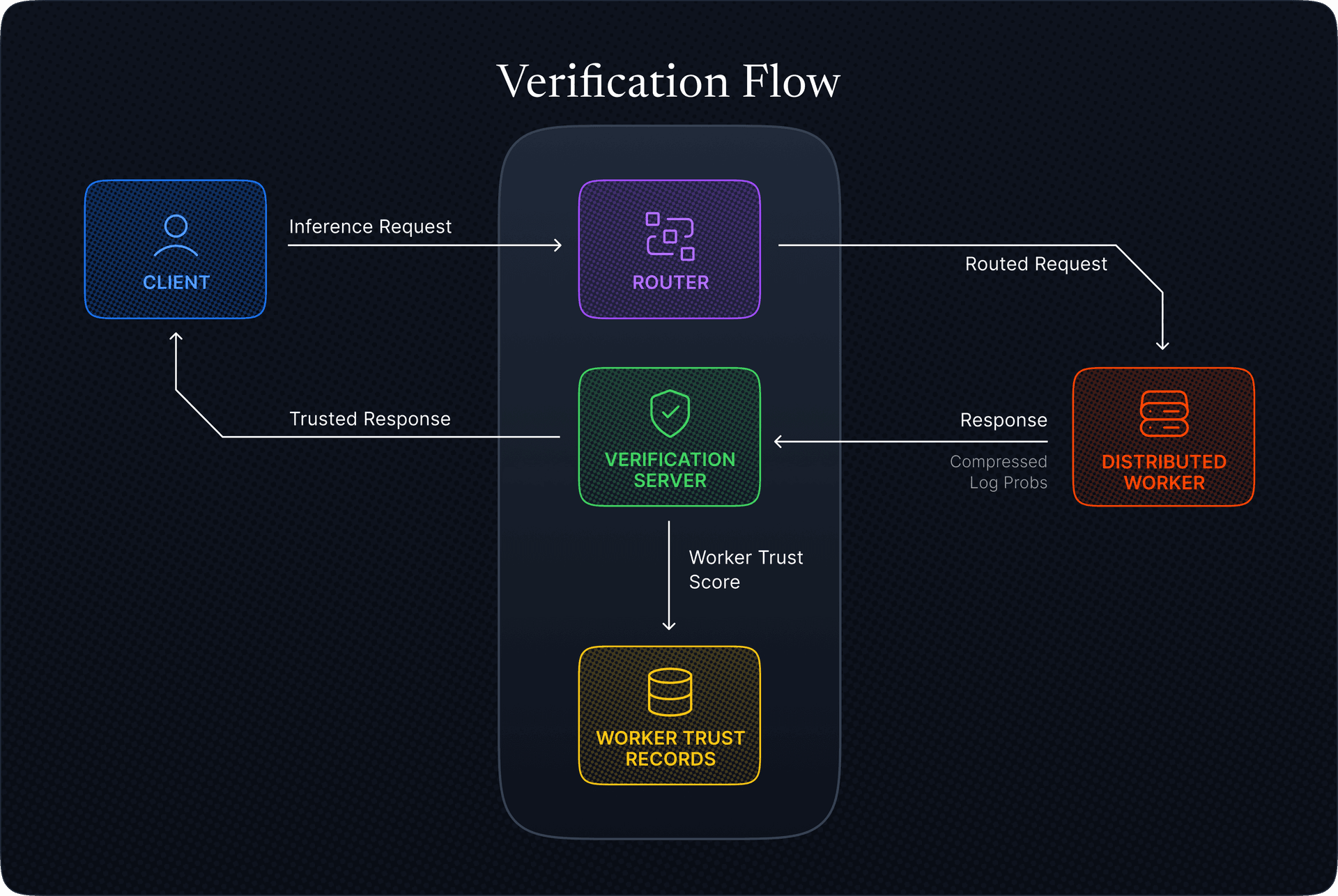
Set up fallback mechanisms for failed verifications. If a node fails verification multiple times, blacklist it from future tasks. Redirect the task to a new node in the pool. Log the failure details for audit purposes. This maintains the integrity of the decentralized network by removing bad actors.
3. Manage Incentives and Slashing
Verification only works if nodes are motivated to be honest. Implement a staking mechanism where nodes deposit crypto assets. If a node submits a result with a failed verification, slash a portion of their stake. Distribute the slashed funds to the verifier or the protocol treasury. This economic layer is what enforces security in the absence of a central authority.
4. Monitor Network Health
Continuously monitor the verification success rate across your node pool. A sudden drop in success rates may indicate a coordinated attack or a bug in the verification library. Adjust the difficulty of the verification tasks or the stake requirements if the network becomes too expensive or too slow. Regular audits of the verification logic are essential to prevent exploits.
Reduce latency for agent workflows
Agents fail when the model hangs. In a 2026 decentralized inference setup, the bottleneck is usually the round-trip time to a central server. You must distribute nodes geographically so requests hit the nearest available compute. This cuts network lag and keeps agent loops moving.
1. Map your agent’s critical path
Identify which prompts require sub-second responses. These are your latency-sensitive tasks. Route these to edge nodes in the same region as the user. Reserve heavier, batched tasks for central cloud clusters.
2. Deploy edge nodes in high-density zones
Place inference containers in regions where your users actually are. Use a provider that supports global edge distribution. This ensures that a user in Tokyo hits a Tokyo node, not one in Frankfurt.
3. Use dynamic request routing
Configure your load balancer to check node health and distance before routing. If a local node is busy, failover to the next closest region. Do not let requests queue up in a single location.
4. Monitor and adjust
Track latency metrics for each region. If a specific node becomes a bottleneck, rotate traffic or add capacity. Continuous monitoring keeps your agent responsive as user patterns shift.
Check Your Deployment Readiness
Before routing live traffic, run through this final verification. Decentralized inference 2026 demands strict alignment between your node configuration and the underlying protocol. A mismatch here breaks verifiability and inflates costs.
Pre-Launch Checklist
-
Node Health: Verify all participating nodes are online and syncing with the latest model shards.
-
Security Audit: Confirm that zero-knowledge proofs or verifiable computation layers are active and generating valid receipts.
-
Cost Caps: Set hard limits on inference latency and token pricing to prevent runaway expenses during traffic spikes.
-
Fallback Logic: Ensure your application can gracefully degrade to a centralized endpoint if the decentralized network stalls.
Final Verification Steps
- Test Inference Latency: Send a batch of 100 queries. Measure the time from request to verified response. If latency exceeds your SLA, check node proximity.
- Validate Proof Generation: Monitor the node logs. Ensure every response includes a valid cryptographic proof. Missing proofs indicate a configuration error in the verification layer.
- Load Stress Test: Simulate 5x normal traffic. Observe how the network distributes shards. If nodes drop offline, adjust your redundancy settings.
Check that all nodes have downloaded the latest model weights and are aligned with the current block height. Mismatched versions cause proof failures.
Submit a test query and inspect the returned proof. Ensure the cryptographic signature matches the node's public key and the model state.
Watch the gas fees and compute costs during the test. If costs spike unexpectedly, check for inefficient shard distribution or redundant computations.
No comments yet. Be the first to share your thoughts!