
Get decentralized inference right
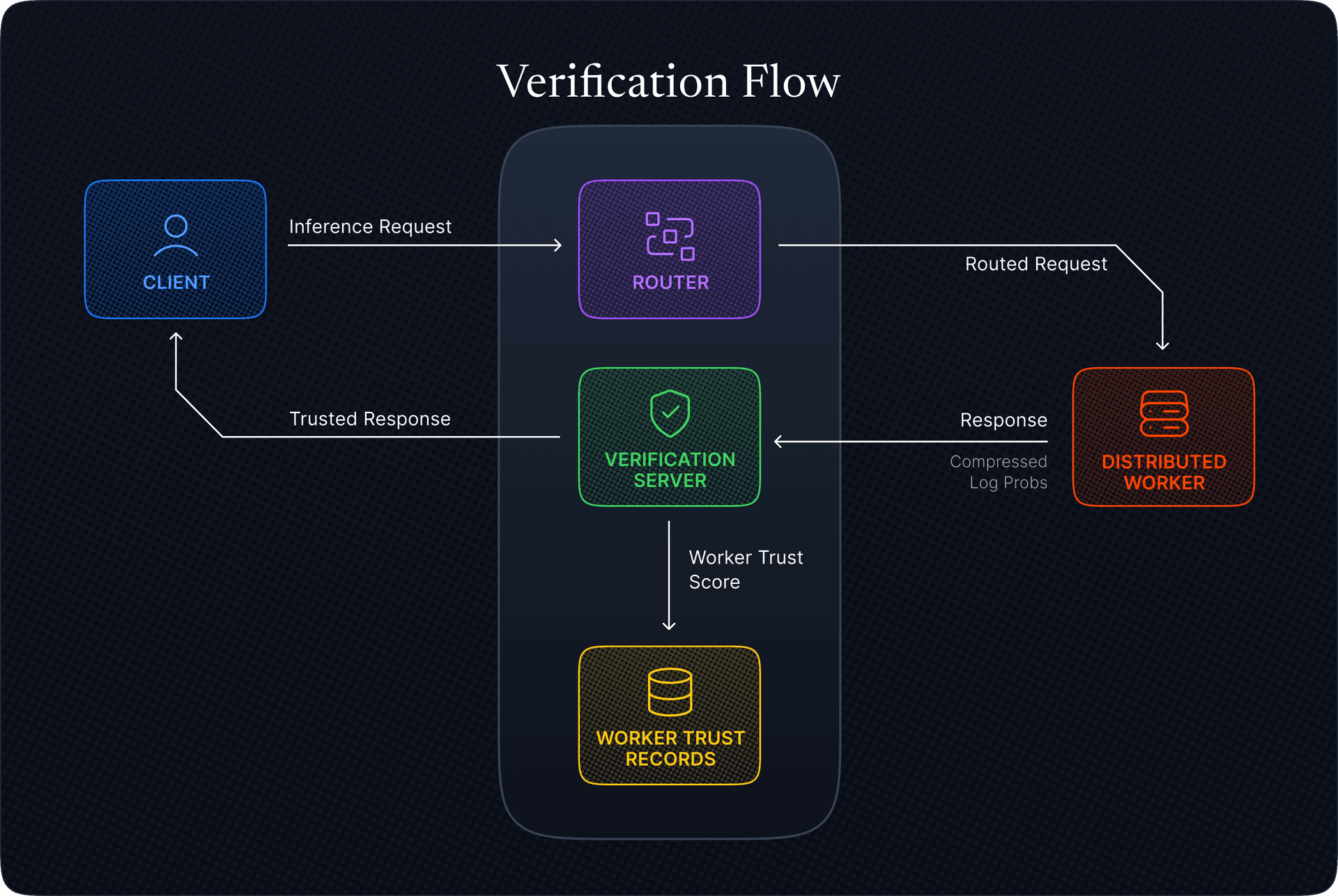
Before you deploy, treat verification as a feature, not an afterthought. Decentralized inference splits model execution across nodes, which introduces latency and security tradeoffs that cloud providers don’t have. You need to pick a verification method that matches your latency tolerance and budget.
There are three main approaches: zero-knowledge proofs (ZKPs), optimistic fraud proofs, and cryptoeconomics. ZKPs are the most secure but computationally expensive. Optimistic proofs are faster but rely on challengers. Cryptoeconomics use staking and slashing to deter bad actors. Choose based on whether you prioritize speed or absolute correctness.
1. Choose your verification model
Zero-Knowledge Proofs (ZKPs) ZKPs allow nodes to prove they ran the computation correctly without revealing the input or output. This is the gold standard for security but requires significant GPU power and memory. Use this if your application handles sensitive data or requires absolute mathematical certainty.
Optimistic Fraud Proofs Optimistic networks assume nodes are honest unless proven otherwise. If a result looks wrong, a challenger can submit a proof of fraud. This is much cheaper and faster than ZKPs but introduces a challenge period (often 24-48 hours) before results are final. Use this for non-critical or high-volume tasks.
Cryptoeconomic Security This approach relies on economic incentives. Nodes stake tokens to participate. If they behave maliciously, their stake is slashed. This is the most common model for current decentralized inference markets (like Bittensor or Akash). It’s fast and cheap but relies on the economic security of the network, not mathematical proofs.
2. Check node requirements
Ensure your target nodes have the necessary VRAM and compute power. LLM inference is memory-bound. A 7B parameter model in FP16 requires ~14GB of VRAM. If you’re using quantized models (INT8 or INT4), you can run larger models on smaller GPUs, but accuracy may drop. Verify the node’s hardware specs before submitting your job.
3. Test with small batches
Start with a small batch of requests to measure latency and success rates. Decentralized networks can have variable performance. Monitor the time it takes for a node to accept your job, run the inference, and return the result. If the latency is too high, consider switching to a different verification model or a different network.
4. Monitor and verify
Set up monitoring to track node performance. If a node consistently fails or returns incorrect results, report it. In cryptoeconomic networks, this helps the community identify bad actors. In ZKP networks, you can automatically verify the proof before accepting the result.
Work through the steps
Why is the Year of Edge AI works best as a clear sequence: define the constraint, compare the realistic options, test the tradeoff, and choose the path with the fewest hidden costs. That order keeps the advice usable instead of decorative. After each step, pause long enough to check whether the recommendation still fits the reader's actual situation. If it depends on perfect timing, unusual access, or a best-case budget, include a simpler fallback.
Common Mistakes in Decentralized Inference
Most projects treating decentralized inference as a simple cloud replacement fail because they ignore the verification layer. The core error is assuming that cheaper compute automatically equals better performance. In reality, the bottleneck is proving that the computation was correct without re-executing it.
Ignoring Verification Overhead
The biggest trap is underestimating the cost of validity proofs. Whether you use zero-knowledge proofs (ZKPs) or optimistic fraud proofs, the computational overhead can negate the savings from decentralized GPUs. If your proof generation time exceeds the inference time, the system becomes unusable for real-time applications. Always benchmark the proof generation latency against your acceptable response time threshold.
Misaligned Incentives
Another frequent failure mode is designing economic incentives that don't match the risk profile. If the staking requirements are too low, bad actors can spam the network with incorrect results. If they are too high, you lose liquidity and participation. The design must ensure that the cost of cheating exceeds the potential reward, but not so high that it blocks legitimate nodes from joining.
Poor Network Topology
Finally, many teams deploy nodes in a flat network without considering latency or geographic distribution. Decentralized inference relies on rapid communication between nodes for consensus and verification. A scattered topology increases round-trip times, leading to timeouts and failed inferences. Place nodes close to each other in regions with high bandwidth and low latency to maintain system stability.
Decentralized inference: frequently asked: what to check next
How do decentralized networks verify AI results?
Decentralized inference relies on three main verification approaches: zero-knowledge proofs, optimistic fraud proofs, and cryptoeconomics. Instead of trusting a single provider, the network uses these cryptographic methods to ensure the output matches the model's weights. This "don't trust, verify" architecture allows fragmented nodes to serve large language models securely without a central authority.
Is decentralized inference faster than cloud APIs?
Not necessarily. Because the model is split across multiple nodes, you may experience higher latency compared to a centralized cloud API. Networks like Wavefy are designed to handle high-latency real-world conditions, but the distributed nature of the computation means inference can be slower. However, this tradeoff often yields lower costs and greater data privacy.
Can I use decentralized inference for large language models?
Yes. The primary use case for decentralized inference is serving large language models (LLMs) that are too large for a single GPU. By partitioning the neural network into fixed blocks of layers, the system distributes the workload across the network. This makes it possible to run complex models on consumer hardware or small clusters.
What are the main risks of using decentralized AI?
The biggest risks involve network instability and verification complexity. If nodes drop offline, the inference process may fail or require re-routing. Additionally, verifying the correctness of the output requires significant computational overhead. Users must balance the benefits of decentralization against the potential for increased latency and technical complexity.
No comments yet. Be the first to share your thoughts!